
What Is a GVM Upgrade? Australian Engineering Guide

Updated: Aug 10
A Gross Vehicle Mass (GVM) upgrade increases the maximum permitted mass of a motor vehicle when loaded. It may provide additional capacity for passengers, accessories, tools, fuel, water and towball download—but only within the vehicle's other ratings and the conditions of the approval.
A GVM upgrade is not simply a suspension upgrade, and it does not automatically increase Gross Combination Mass (GCM), braked towing capacity or axle ratings.
What is GVM?
GVM is the maximum permitted mass of the vehicle when loaded. The vehicle's actual mass includes the vehicle itself plus occupants, fuel, accessories, cargo and any load imposed through the tow coupling.
Payload is not a separate certified rating. It is the practical difference between the permitted GVM and the vehicle's actual unladen or operating mass. Every accessory added to the vehicle reduces the remaining payload.
When might a GVM upgrade be needed?
Owners commonly investigate a GVM upgrade after adding equipment such as:
a bullbar, winch or underbody protection;
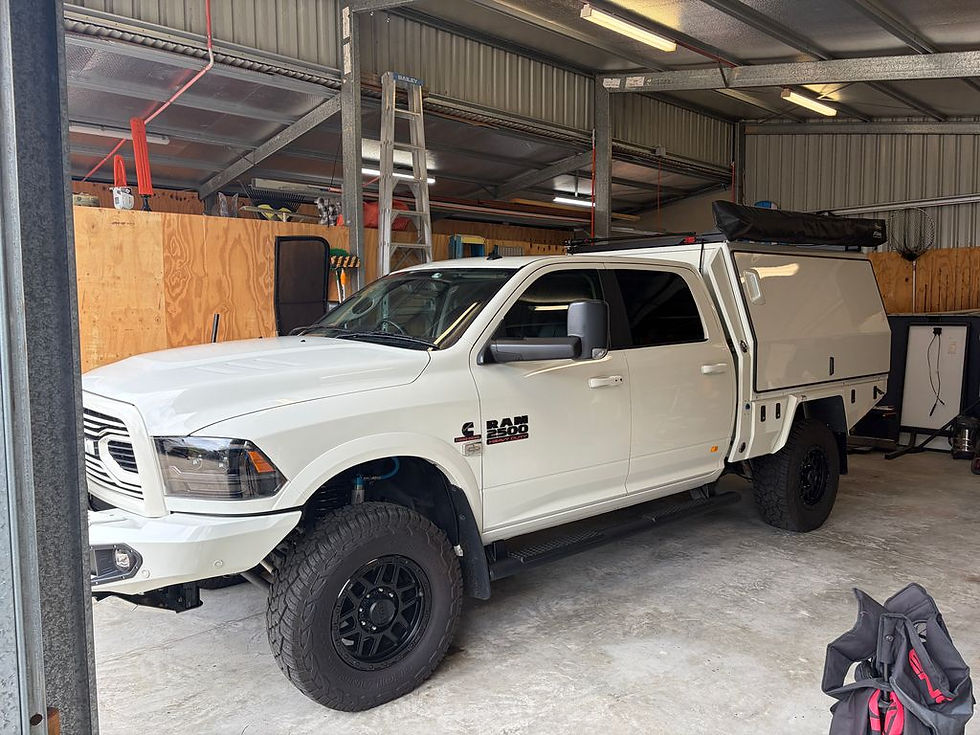
a canopy, tray or service body;
auxiliary fuel, batteries or water;
tools and work equipment;
touring equipment and recovery gear;
passengers and luggage; or
towball download from a coupled trailer.
The first step is to weigh the vehicle in a representative operating condition. Record individual axle-group masses as well as total vehicle mass. A vehicle can be below GVM but still exceed an axle, tyre or wheel rating.
What does a GVM upgrade change?
An approved GVM increase changes the permitted total loaded mass of the motor vehicle. The approval may also specify revised axle ratings or operating conditions, but these must be stated and supported separately.
It does not automatically change:
GCM;
braked towing capacity;
towbar or towball-download limits;
every axle rating;
tyre or wheel ratings; or
legal road-access mass limits.
All applicable limits must be satisfied simultaneously.
Is fitting heavier suspension enough?
No. Springs primarily support load and control ride height. A rating assessment may also need to consider dampers, axles, wheels, tyres, brakes, steering, wheel bearings, chassis, stability, electronic safety systems and component durability.
The required modifications and evidence depend on the vehicle and target rating. Some approved packages rely on vehicle-specific testing and engineering evidence. A collection of individually high-rated parts does not, by itself, establish a higher vehicle rating.
Pre-registration and post-registration upgrades
Before first registration
A new vehicle may be modified under an approved Second Stage of Manufacture (SSM) pathway before first supply. The completed vehicle must be covered by the appropriate Commonwealth approval and entered on the Register of Approved Vehicles.
After registration
An in-service GVM upgrade is administered by the state or territory registration authority. The technical and certification pathway varies by jurisdiction and may involve a recognised signatory, approved kit, engineering report, inspection, modification plate, certificate, permit or registration update.
An SSM approval for a new vehicle is not automatically a post-registration approval for an already registered vehicle.
Light and heavy vehicles
A motor vehicle with a GVM not exceeding 4.5 tonnes is generally assessed through the relevant light-vehicle framework, which may draw on VSB 14 and jurisdiction-specific codes.
A motor vehicle with a GVM greater than 4.5 tonnes is a heavy vehicle for modification purposes. VSB 6 Section S contains the national technical pathway for certain heavy-vehicle rating changes, subject to the applicable regulator and jurisdiction.
Classification is based on GVM, not GCM alone.
Typical GVM-upgrade process
Weigh the loaded vehicle by axle group.
Define the required operating mass and configuration.
Confirm the registration jurisdiction and whether the vehicle is pre- or post-registration.
Check the available approval pathway before buying parts.
Assess the vehicle and supporting evidence for the target rating.
Install the approved components and retain traceability records.
Complete the required inspection and testing.
Obtain the approval documentation and update registration records where required.
Disclose the modification to the insurer and confirm cover.
Frequently asked questions
Does a GVM upgrade increase towing capacity?
Not automatically. Towing remains limited by GCM, braked towing capacity, towbar and coupling limits, trailer ratings, axle ratings and other applicable limits.
Can the sum of the axle ratings exceed GVM?
Yes. Manufacturers often provide some load-distribution flexibility, so the sum of individual axle ratings may exceed GVM. That does not permit the vehicle to exceed its approved GVM.
Can any mechanic approve a GVM increase?
No. A workshop may install approved components, but the rating change must follow the approval and certification process accepted by the relevant jurisdiction.
Is a GVM upgrade recognised interstate?
Do not assume automatic recognition. A receiving registration authority may require additional evidence or assessment. Confirm before transferring a modified vehicle interstate.
Official references
Technical content reviewed 13 August 2026. Requirements vary by vehicle and jurisdiction and should be confirmed before modification.
For the commercial service and available vehicle pathways, visit KME's GVM upgrade service. For the customer process, see How to get a GVM upgrade.
Comments