
Overloaded 4WD Legal Risks in Australia: Myths vs. Reality (2026 Guide)

Updated: Sep 9
Imagine you are 500 kilometres into a dream trip through the Kimberley when a sudden swerve leads to a structural failure. You are safe, but your insurer has sent a surveyor to check your weights, and they have discovered you are 150kg over your Gross Vehicle Mass. In an instant, a simple oversight turns into a rejected claim and a massive personal liability. Understanding overloaded 4WD legal risks Australia wide is no longer just about avoiding a roadside fine; it's about protecting your life savings from a "she'll be right" gamble that the 2026 legal system won't tolerate.
We know how confusing the sea of GVM and GCM acronyms can be, especially when you're just trying to pack the essentials for a remote tour. It feels like the rules are constantly shifting, and the reality of a $4,260 fine at a Tasmania weighbridge is enough to ruin any holiday. This guide will clarify exactly where the legal lines are drawn and how engineering compliance can restore your peace of mind. We'll examine the latest 2026 penalty increases, debunk common weight myths, and explain how to ensure your vehicle remains a legal, safe asset on any track.
Planning your journey involves more than just vehicle safety; for those looking for comfort between remote tracks, you can explore hotel accommodation reservations to secure your next stay and ensure a well-deserved rest.
Table of Contents
The "She’ll be Right" Myth: Overloaded 4WD Legal Risks in Australia
In the Australian 4WD community, the phrase "she’ll be right" is often used to justify carrying an extra spare tyre, a full fridge, and 100 litres of water on a standard chassis. However, the legal reality is governed by the Gross Vehicle Mass (GVM), a figure set by the manufacturer to comply with Australian Design Rules (ADRs). When you exceed this limit, you are operating an unroadworthy vehicle. The overloaded 4WD legal risks Australia wide are severe, ranging from immediate fines to the total voiding of your insurance policy. To understand the foundations of these limits, it's helpful to review the global context of Australian vehicle weight regulations, which dictate how mass is distributed across axles and chassis.
The "everyone does it" mentality fails the moment you are pulled over at a roadside scale or, worse, involved in a collision. Police and transport authorities don't care about what your mates are doing; they care about the compliance plate fixed to your firewall. If the numbers on the scale exceed the numbers on that plate, your journey ends there. You can't argue your way out of physics or the law by claiming the car "feels fine" to drive.
Developing the mental clarity to move beyond these common myths is essential for safe touring; if you're seeking to enhance your mindset and personal growth, you can explore Coaching and Transformational Programs to help achieve your long-term goals.
Common Myths vs. Engineering Reality
Many owners believe that bolting on aftermarket parts solves the problem of weight. This is a dangerous misconception that ignores the holistic engineering of the vehicle.
Myth: Airbags increase your GVM. Reality: Airbags are designed to level a load for better headlight aim and handling; they do not increase the legal carrying capacity of the chassis or axles.
Myth: If the car doesn’t sag, it isn’t overloaded. Reality: Modern heavy-duty suspension can hide a massive load, but the stress on your wheel bearings, braking system, and chassis remains. Structural limits are often invisible until a catastrophic failure occurs.
Myth: GVM is just a suggestion by the manufacturer. Reality: It is a legally binding safety rating. Exceeding it means you are operating outside the vehicle's tested engineering parameters.
The Legal Framework: VSB14 and Your Responsibilities
Modifications in Australia are governed by the National Code of Practice, specifically Vehicle Standards Bulletin 14 (VSB14). This document outlines what is considered a minor modification and what requires a formal engineering signatory. If you change your suspension to handle more weight, you are crossing into territory that demands a modification plate and professional certification.
Relying on "self-certification" or the word of a salesperson is a recipe for legal disaster during a registration check or an insurance investigation. Without a Blue Plate or an equivalent state-based modification certificate, your vehicle does not meet the necessary safety standards for public roads. This lack of compliance is exactly what authorities look for during roadside inspections. If you haven't had an engineer verify that your GVM upgrade meets the required standards, your 4WD is legally considered overloaded, regardless of how many heavy-duty springs you've installed.
Physics vs. The Law: Why GVM is More Than Just a Number
Gross Vehicle Mass is not an arbitrary figure dreamed up by a bureaucrat. It is an engineering boundary where mechanical components transition from reliable to unpredictable. Physics doesn't care about your holiday plans. When a vehicle is loaded beyond its GVM, the centre of gravity shifts higher and further back, which fundamentally alters the way the chassis responds to sudden steering inputs. This mechanical strain is the primary driver behind overloaded 4WD legal risks Australia wide, as authorities increasingly view weight violations as a deliberate choice to operate an unsafe vehicle.
The law treats mechanical failure differently when a vehicle is over-mass. If a component like a wheel stud or steering rack fails on a compliant vehicle, it is an accident. If that same component fails while you are 200kg over your limit, it is negligence. This distinction is what transforms a mechanical breakdown into a legal liability that can haunt you for years.
Braking and Electronic Stability Control (ESC)
Modern 4WDs rely on complex Electronic Stability Control (ESC) and Anti-lock Braking Systems (ABS) that are calibrated to specific mass ranges. When you exceed these limits, the software's mathematical models for traction and momentum no longer align with reality. Excess weight overwhelms factory braking hardware, leading to significant brake fade and dangerously increased stopping distances. During an emergency stop, the way weight shifts forward creates a dynamic load that can exceed the front axle's capacity, potentially leading to a loss of steering control. In a court of law, your legal culpability for a collision increases the moment it is proven that your vehicle could not stop within the distance intended by the Australian Design Rules.
Axle and Chassis Fatigue: The Invisible Danger
Chassis failure, particularly the "snapped chassis" seen in many dual-cab utes, is rarely the result of a single bump. It is usually the product of long-term fatigue caused by improper weight distribution. Your rear axle is typically the first point of both physical and legal failure. Even if you are under your total GVM, you may still be exceeding the individual axle load rating, which is a common trap for those carrying heavy canopies or large fuel tanks.
Structural integrity is non-negotiable. If you are planning to haul heavy loads or want to increase towing capacity legally in Australia, you must address the engineering requirements of the entire platform. Simply adding a tow bar or a set of springs does not change the structural limits of the steel. Ensuring your setup is verified through a professional compliance inspection is the only way to guarantee that your chassis can handle the stress of remote touring without becoming a legal or safety statistic.
The Cost of Non-Compliance: Insurance, Fines, and Liability
While a snapped chassis is a physical disaster, the financial fallout of overloaded 4WD legal risks Australia wide can be even more devastating. If you're involved in a collision while over-mass, you aren't just looking at a repair bill; you're facing a potential total loss of your assets. The legal system views an overloaded vehicle as inherently negligent. In a serious accident, this can lead to civil litigation where your home and savings are at stake. When you operate outside the manufacturer's specified limits, you're essentially self-insuring against a multi-million dollar liability claim.
The transition from a "minor oversight" to a life-changing legal battle happens the moment a surveyor measures your vehicle's weight post-accident. This isn't just about the police; it's about the civil lawyers who will use your vehicle's non-compliance to prove a breach of duty of care. The stakes are simply too high to rely on luck.
This level of legal risk is not unique to Australia; in any jurisdiction, a robust defence is vital when facing significant liability. For those with legal interests in South America, you can explore criminal defence services and legal representation with Abogado Penalista Chile to ensure your rights are protected.
Insurance: The "Fine Print" Trap
Many owners believe that as long as they've listed their bull bar and canopy as accessories on their policy, they're covered. This is a dangerous misconception. Insurance Product Disclosure Statements (PDS) almost universally contain a clause regarding "unauthorised modifications" or "unroadworthy vehicles." If a post-accident inspection reveals your vehicle was operating above its GVM, the insurer can argue that the vehicle was unroadworthy at the time of the incident.
This effectively voids your comprehensive cover, leaving you to pay for your own repairs and, more crucially, the damages to third parties. In this context, an engineer’s certificate acts as an insurance policy for your insurance, providing the legal verification that your vehicle is fit for its intended purpose and mass. Without that plate, you're giving your insurer a "get out of jail free" card.
Roadside Enforcement and Penalties
State authorities have significantly increased their focus on vehicle mass. Mobile weighbridges are now a common sight during peak touring seasons, often under initiatives like "Operation Scales" targeting modified 4WDs and caravans. As of July 2026, the penalties for using an over-mass light vehicle have reached record levels. In Tasmania, for instance, a first offence can result in a fine of up to $4,260, while subsequent offences can climb to $8,520. South Australia has also indexed its traffic fines to the CPI, leading to steep increases for safety-related breaches across the board.
Beyond the financial hit, a "Major Defect" notice is the ultimate holiday killer. This notice grounds your vehicle immediately. You cannot drive it until the excess weight is removed or the vehicle is re-certified. This often creates a logistical nightmare where owners are forced to leave expensive camper trailers or camping gear on the side of a remote road because their tow vehicle is legally incapable of moving them. The peace of mind provided by a certified modification plate far outweighs the cost and stress of these potential penalties.
While ensuring your 4WD is compliant is essential for local touring, those looking to trade the outback for a luxury international escape can find curated experiences through The Real South Africa Travel and Tourism.
Calculating Your True Payload: A Step-by-Step Compliance Check
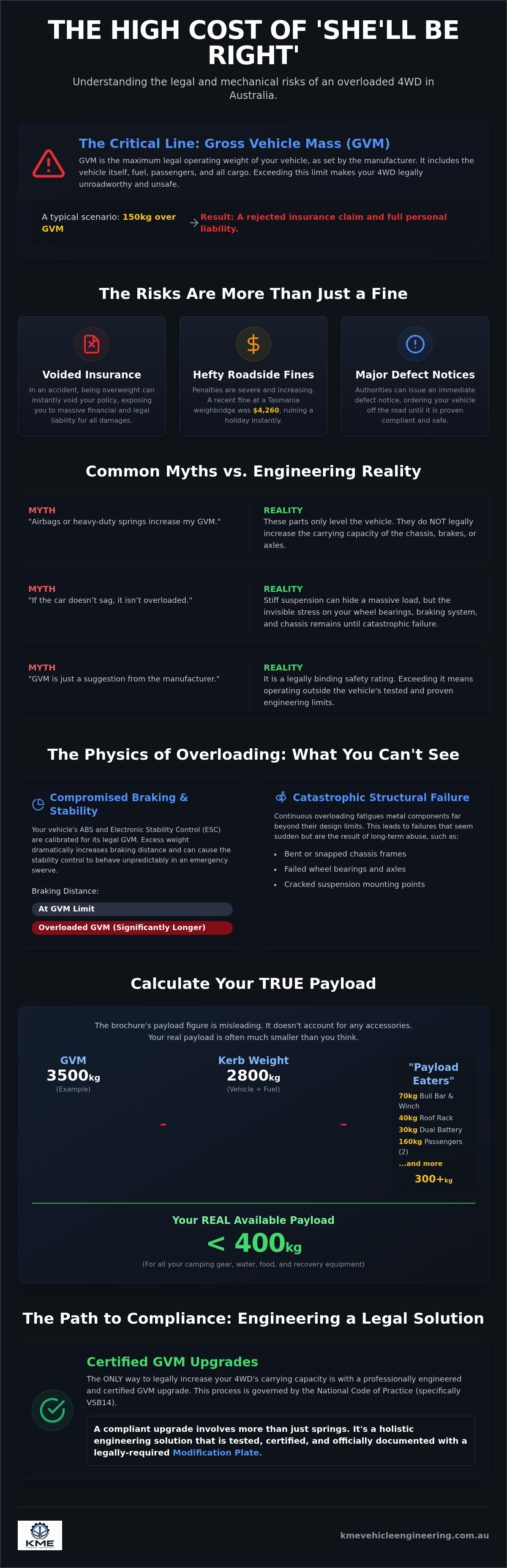
Most owners rely on the "Kerb Mass" found in their vehicle's glossy brochure. This is a mistake. That figure represents the vehicle in its absolute lightest form, often without a full tank of fuel, accessories, or even floor mats. To navigate overloaded 4WD legal risks Australia wide, you need to start with the actual weight of your specific vehicle as it sits in your driveway. Brochures don't include your bull bar. They don't include your driving lights. Every kilogram added since the showroom floor is a kilogram subtracted from your legal payload.
A critical and often overlooked factor is Tow Ball Mass (TBM). If you're towing a caravan or camper, the weight pressing down on your tow bar is legally considered part of your vehicle's payload, not the trailer's. If your van has a 300kg TBM, that is 300kg immediately wiped off your GVM. For many stock dual-cab utes with a payload of around 900kg, once you add a family of four, some tools, and a full tank of diesel, that 300kg TBM can push you into illegal territory before you've even packed a suitcase.
This payload pressure is a daily reality for rural property owners who use their vehicles to transport heavy livestock feed; for expert guidance on selecting quality products, check out Gidge Rural.
The Weighbridge Process
The only way to get a definitive answer is to visit a local public weighbridge. You should weigh the vehicle in "touring trim," meaning exactly how it would be loaded for a trip, including passengers, water, and fuel. A total mass reading is helpful, but an axle-by-axle breakdown is better. This involves positioning just the front wheels on the scale, then the whole vehicle, then just the rear wheels. When you receive your ticket, you can compare these results against the what is a GVM upgrade standards to see how much "breathing room" you actually have left. Often, the rear axle is over its limit while the total GVM is still technically compliant.
The Payload Reality Check
It is eye-opening to see how quickly common accessories consume your legal limit. A steel bull bar and winch combo can easily exceed 110kg. A dual battery system, roof rack, and a 60-litre fridge add another 100kg. Even a premium 300 Series LandCruiser suspension kit, while improving handling, doesn't change the fact that four adults and a drawer system can bring the vehicle to its factory limit. If your weighbridge ticket shows you are within 5% of your GVM, you are in the "danger zone" for dynamic weight shifts during emergency manoeuvres. Before committing to a full engineering solution, consider whether you can swap steel components for aluminium or reduce the amount of water carried on board. If the numbers still don't stack up, it's time to book a vehicle compliance inspection to discuss a certified engineering path forward.
Engineering a Legal Solution: The Role of Certified GVM Upgrades
A certified GVM upgrade is a comprehensive engineering solution that redefines your vehicle's legal capacity. It isn't just about swapping factory springs for stiffer aftermarket units. A true upgrade involves a holistic assessment of the braking system, axle load ratings, and chassis strength to ensure the vehicle still meets Australian Design Rules (ADRs) at its new, higher mass. This process is the only legitimate way to eliminate overloaded 4WD legal risks Australia wide, providing you with a vehicle that is both physically capable and legally recognised by transport authorities and insurers.
The final piece of this puzzle is the Blue Plate or Modification Plate. This small piece of metal, fixed to your vehicle, serves as a permanent record of the engineering work performed and certified. It acts as your primary defence during roadside inspections or registration checks. Without this plate, any heavy-duty suspension work is merely a modification; with it, it becomes a certified legal capacity increase. KME Vehicle Engineering acts as the bridge between "modified" and "legal," ensuring your vehicle's new limits are backed by rigorous testing and documentation.
The Certification Process
During the certification process, an engineer assesses your vehicle’s structural integrity and braking capacity to determine if it can safely handle a higher mass. This involves comparing the proposed modifications against the standards set out in the National Code of Practice. There is a distinct difference between "pre-rego" (Federal) upgrades, which are performed on new vehicles before their first registration, and "post-rego" (State-based) upgrades, which apply to vehicles already on the road. For those managing commercial fleets or heavy-duty fit-outs, a deep vsb6 understanding is vital, as this code governs modifications for heavy vehicles and ensures large-scale builds remain within the law.
Investing in Peace of Mind
Choosing a certified upgrade is an investment in your vehicle's long-term value and safety. A legal GVM upgrade often increases resale value, as buyers are increasingly aware of the overloaded 4WD legal risks Australia has made a priority for enforcement. More importantly, it ensures your family or fleet is safe for the harsh conditions of the Australian outback. You don't want to be second-guessing your chassis strength when you're thousands of kilometres from the nearest town. Ensuring your modifications are signed off by a qualified professional is the only way to travel with genuine confidence. Contact KME Vehicle Engineering for a compliance inspection today to ensure your touring setup is fully legal and safe for your next adventure.
Securing Your Future on the Tracks
The Australian outback is no place for a vehicle operating at its mechanical breaking point. We have established that legal weight limits are precise engineering boundaries; ignoring them creates a cascade of overloaded 4WD legal risks Australia wide. From the rejection of insurance claims to the terrifying prospect of personal civil liability, the consequences of a "she'll be right" attitude far outweigh the effort of a compliance check. You now have the tools to calculate your true payload and understand why a certified modification plate is your most valuable accessory.
As specialists in GVM, GCM, and ATM upgrades, we provide the technical mastery needed to ensure your vehicle meets national engineering standards. Whether you require expert 300 Series LandCruiser compliance or a full commercial fleet fit-out, the goal is always peace of mind. Don't leave your safety or your life savings to chance when a verified solution is within reach. Get your vehicle engineered for legal peace of mind with KME. Safe travels start with a compliant vehicle, and we are here to help you navigate the path to a worry-free adventure.
Frequently Asked Questions
Can I get fined for being just 50kg over my GVM in Australia?
Yes, you can be fined for any amount exceeding your vehicle's plated Gross Vehicle Mass. There is no legal "buffer" or grace period for being slightly over the limit. In jurisdictions like Tasmania, the 2024 regulations specify fines of up to $4,260 for a first offence of using an overmass light vehicle. Roadside authorities use calibrated mobile scales to ensure 100% accuracy during inspections.
Will my insurance definitely be void if I have an accident while overloaded?
Your insurance claim is at high risk of being denied if the vehicle's weight contributed to the incident or rendered the vehicle unroadworthy. Australian insurers typically include clauses in their Product Disclosure Statements that exclude coverage for vehicles operated outside of legal weight limits. If a post-accident inspection reveals you were over-mass, you could be left personally liable for all repair costs and third-party damages.
How do I know if my 4WD needs a GVM upgrade or just better springs?
You need a GVM upgrade if your weighbridge ticket shows you have exceeded the manufacturer's plated mass. Heavy-duty springs only improve the ride height and load-levelling capabilities; they do not change the legal carrying capacity of the vehicle. To mitigate overloaded 4WD legal risks Australia wide, you must have an engineering certification and a modification plate that officially increases your vehicle's legal limits.
Does a GVM upgrade also increase my Gross Combined Mass (GCM)?
Not automatically, as GVM and GCM are separate legal ratings. While some engineering packages cover both, you must verify that your specific certification explicitly includes a GCM increase. Recent technical bulletins in Western Australia, such as VTB-181A, have clarified the strict standards required for safely increasing these limits. Always check your modification plate to confirm which ratings have been officially adjusted by the engineer.
What is the difference between a GVM upgrade and a suspension lift kit?
A suspension lift kit is designed to increase ground clearance, whereas a GVM upgrade is a legal certification of increased load capacity. While a GVM upgrade usually involves fitting heavy-duty suspension components, it also includes engineering verification of braking performance and structural integrity. A standard lift kit without engineering sign-off does not grant you any extra legal payload and may even affect your vehicle's stability.
Is a GVM upgrade done in one state legal to drive in all other Australian states?
Yes, a GVM upgrade certified under the National Code of Practice (VSB14) or a recognised state-based scheme is legal for interstate travel. Once a modification plate is fitted by a qualified engineer, the vehicle is considered compliant across all Australian jurisdictions. Federal "pre-registration" upgrades offer the most seamless recognition, but state-certified "post-registration" modifications are also widely accepted provided the paperwork is kept in the vehicle.
What happens if I snap my chassis while driving an overloaded vehicle?
You will likely face a total loss of insurance coverage and a Major Defect notice from transport authorities. A snapped chassis is often the result of long-term fatigue caused by exceeding axle limits. To return the vehicle to the road, you will require a certified structural repair plan and a follow-up compliance inspection. In many cases, the cost of repair and re-certification exceeds the market value of the vehicle.
Do I need an engineer’s certificate for a bull bar and a winch?
You do not usually need an engineer's certificate for these accessories provided they are ADR-compliant and don't exceed your front axle's load rating. However, if the combined weight of your bull bar, winch, and other accessories pushes the vehicle over its total GVM, you are legally required to obtain a GVM upgrade. It is your responsibility to ensure that the addition of heavy accessories does not render the vehicle unroadworthy.


Comments