
300 Series LandCruiser GVM Upgrade: Checks Before You Buy

Updated: 2 days ago
A 300 Series LandCruiser GVM upgrade can increase the vehicle’s permitted loaded mass where an appropriate approval pathway exists. Start with the exact vehicle, its loaded axle masses and the registration jurisdiction. A suspension lift alone does not establish a higher GVM, and a GVM increase does not automatically increase GCM or towing capacity.
Before buying suspension, wheels or towing equipment, confirm which complete configuration can be assessed. This article focuses on those buying decisions; KME’s LandCruiser 300 Desert GVM Kit service sets out the dedicated product pathway.
Planning a 300 Series LandCruiser GVM upgrade: five checks
1. Identify the exact vehicle
Provide the build year, variant, powertrain, seating requirements and registration state or territory. Include existing suspension, tyres, wheels, tow equipment and other modifications. Do not assume that a configuration for one GX, GXL, VX, Sahara, GR Sport or Sahara ZX also covers another vehicle, or that diesel and hybrid eligibility is interchangeable.
2. Measure the load you actually carry
KME recommends weighing the vehicle in its intended travelling configuration, with front and rear axle results as well as total vehicle mass. Account for accessories, fuel, occupants and cargo. If towing, provide coupled axle masses and the trailer’s loaded mass and towball download. A brochure payload figure cannot describe your completed build.
GVM is the vehicle’s loaded-mass limit; GCM limits the coupled combination. Axle and towing limits also need separate checks. The Transport WA GVM and GCM FAQs explain these definitions and why the maximum vehicle and trailer ratings may not be usable together.
3. Confirm the whole component package
Ask which suspension, wheels, tyres and towing equipment the proposed configuration requires. Do not treat a generic “Stage 1”, “Stage 2” or “heavy duty” label as evidence of eligibility. KME’s Desert Kit service describes an integrated vehicle package; the required components depend on the applicable configuration.
4. Check the towing objective separately
Tell KME the trailer you intend to tow and how the vehicle will be loaded. Specify whether you need additional vehicle payload, a GCM assessment, a towing-capacity assessment, or a combination. Each limit needs its own basis; a higher GVM is not evidence that the other ratings have changed. For terminology, see GVM vs GCM.
5. Confirm the pathway before installation
Establish the vehicle’s supply and registration status before committing to parts. Confirm the applicable approval, installation, inspection, certification and registration steps with the responsible parties. An engineer’s report, an approval record and registration acceptance have different roles.
New vehicle or already registered?
Planning a new vehicle before supply
The Commonwealth’s Second stage of manufacture guidance describes SSM as modifying a new base vehicle into an alternative vehicle before it has been provided to the Australian market. Registration timing is a useful practical checkpoint, but it is not the entire eligibility test. The base vehicle, approval conditions and RAV requirements also matter.
For a proposed KME Desert build, contact KME before taking delivery or allowing registration so the relevant configuration can be confirmed with the dealer and installer. If the vehicle is being configured primarily for business use, also compare the separate LandCruiser 300 Commercial Build service.
An existing registered LC300
An in-service vehicle needs the applicable state or territory modification pathway. Do not assume that fitting the same parts as a new SSM build reproduces that approval. The Commonwealth’s VSB 14 guidance expressly separates technical requirements from state and territory administrative arrangements.
For example, the NT light-vehicle GVM bulletin sets out engineering, departmental inspection and approval steps for its streamlined pathway. It also distinguishes GVM upgrades from GCM and towing-capacity changes and warns that a modification accepted in the NT may not be accepted for registration elsewhere. Confirm the process for your registering jurisdiction.
A real KME example: GR Sport Desert SSM build
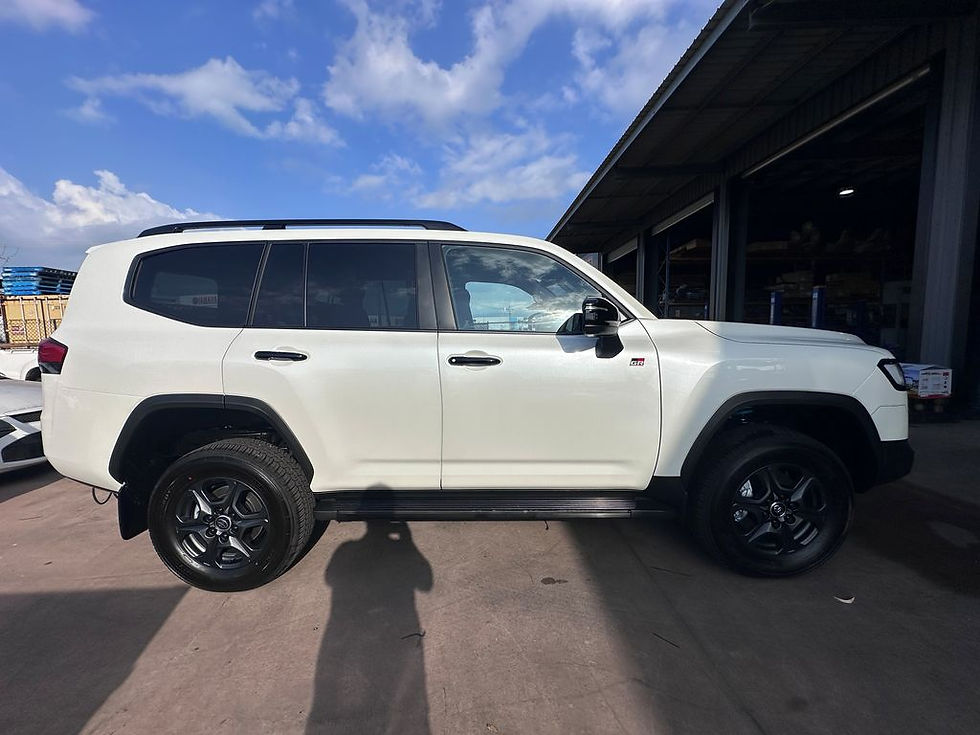
KME’s published Northern Territory project record describes a 2025 LandCruiser 300 GR Sport completed through a pre-registration SSM pathway. Its documented configuration has a 4,000 kg GVM, 7,800 kg GCM, 4,000 kg braked towing capacity and five seats. The build included upgraded springs and rear airbag assistance while retaining the original GR Sport shock absorbers. Those outcomes belong to that specific assessed configuration; they are not blanket ratings or component approvals for every LC300. Read the GR Sport Desert project for the scope and limitations.
Questions to settle before you book
Can existing suspension or wheels be retained?
Send the component details and existing engineering documents for assessment. Retention depends on the proposed configuration and evidence. The GR Sport project above demonstrates one configuration retaining its original shock absorbers; it does not establish that all original components are suitable for every upgrade.
What will it cost, and how long will it take?
Request a quote for the defined scope, including components, installation, inspection, testing and documentation where required. Ask which authority steps and costs sit outside that scope. Timing should be confirmed for the actual vehicle and pathway rather than inferred from a generic inspection or approval timeframe.
What about warranty and insurance?
Modifications may affect warranty or insurance claims, as noted in the NT GVM bulletin. Disclose the proposed changes to the relevant provider and obtain its position for your circumstances. Engineering certification does not guarantee insurance cover or decide a warranty claim.
Send KME the details for a useful assessment
Include your vehicle variant and year, powertrain, current registration jurisdiction and status, existing modifications, intended passenger and accessory loads, available axle weights and towing requirements. KME can then assess the relevant pathway and explain the next evidence or inspection step.
Explore KME’s GVM upgrade assessment service for the broader engineering service.
Source check: 21 October 2026. The featured project uses KME’s existing published project record. Vehicle-specific eligibility and final ratings require assessment of the actual configuration.
Comments