
Automotive Engineering Services: A Guide to Vehicle Compliance in Australia

Updated: Oct 13
Structural or mass modifications should be verified by a suitably qualified professional before the vehicle is relied on for road or commercial use. It's a common dilemma for Australian drivers who need more from their vehicles, whether that's increased towing capacity for a heavy caravan or a bespoke commercial fit-out. You likely feel the frustration of navigating conflicting state regulations and the genuine worry that a single non-compliant part could lead to a grounded vehicle or a insurance claim dispute.
Engaging a vehicle compliance engineer Australia wide is the most effective way to move from uncertainty to total greater confidence. We understand that your vehicle is a significant investment in both utility and adventure. This guide will show you how professional automotive engineering services ensure your modifications meet the current 2026 Australian Design Rules, including the recently updated lighting and emission standards. We'll walk through the methodical process of certifying GVM upgrades and structural repairs, giving you a clear roadmap to a vehicle that is as legal as it is capable.
Table of Contents
What Are Automotive Engineering Services in Australia?
Automotive engineering services involve the technical assessment, design verification, and formal certification of vehicle modifications to ensure they remain safe for public roads. In the Australian context, these services act as the vital bridge between a vehicle owner's requirements and the strict safety standards mandated by law. A vehicle compliance engineer Australia wide serves as an authorised signatory; this is a professional whose tertiary qualifications and registration allow them to provide the legal sign-off required by state transport authorities like Transport for NSW, VicRoads, or Queensland TMR.
Every vehicle manufactured for our market must adhere to the Australian Design Rules (ADRs), which set the national standards for safety, emissions, and structural integrity. When you modify a vehicle, you risk stepping outside these factory-tested parameters. Professional engineering services provide the mathematical proof and physical testing necessary to confirm that changes, such as a GVM upgrade or a custom chassis modification, won't lead to serious mechanical or structural failure or compromised braking performance. Without the required engineering and approval process, a modified vehicle may not satisfy the applicable registration or operating requirements and insurance may also be affected depending on the policy and circumstances.
The Difference Between Mechanical Repairs and Engineering
It's vital to distinguish between a standard mechanical repair and an engineering solution. A mechanic is trained to maintain, repair, and replace components to keep a vehicle running according to its original specifications. They focus on how a part fits and whether it's functioning. An engineer, however, focuses on how a vehicle performs under stress. If you're planning a GVM upgrade or structural repair, a mechanic cannot provide the legal certification because they lack the specific authority to override factory load ratings. Engineering requires complex calculations regarding stress distributions, material fatigue, and braking efficiency to ensure the vehicle can handle its new configuration safely.
Who Needs a Vehicle Compliance Engineer?
You'll likely need the expertise of a vehicle compliance engineer Australia if your build falls into one of these categories:
Individual 4WD Owners: If you've added a bull bar, winch, rear drawers, and a long-range tank, you've likely exceeded your factory mass limits and need a certified GVM upgrade.
Commercial Fleet Operators: Specialised fit-outs for mining, trade or emergency-service use can involve structural or mass changes that may require engineering assessment, certification or other evidence for regulatory, fleet-governance and insurance purposes.
Caravan and Trailer Owners: Increasing the Aggregate Trailer Mass (ATM) to carry more gear safely requires engineering verification of the frame, axles, and braking system.
Choosing an engineered solution over a simple bolt-on approach ensures your vehicle remains a reliable asset rather than a legal liability. It provides the greater confidence that your modifications aren't just functional, but are structurally sound and fully compliant with the latest Australian regulations.
Core Engineering Upgrades: GVM, GCM, and Structural Certification
Australian touring conditions are notoriously harsh. A standard 4WD might look capable on the showroom floor, but once you add a steel bull bar, long-range tank, and a family's worth of gear, you're often perilously close to the factory Gross Vehicle Mass (GVM). For many enthusiasts and fleet operators, this is where a vehicle compliance engineer Australia becomes an essential partner. Modern vehicle platforms require sophisticated, verified solutions rather than simple bolt-on parts. Our 300 Series LandCruiser suspension kits are a prime example of how engineering ensures both performance and legal compliance for one of Australia's most popular touring vehicles.
Moving beyond the vehicle itself, Gross Combination Mass (GCM) and Aggregate Trailer Mass (ATM) are the figures that dictate your towing safety. Increasing these isn't just about fitting a bigger hitch; it's about verifying the structural integrity of the entire combination. GCM remains a complex regulatory area in Australia. While some states allow GCM increases, others are more restrictive, requiring a qualified engineer to assess the drivetrain, cooling capacity, and chassis strength before signing off on any increase in towing capacity. Similarly, modern caravans frequently exceed their factory ATM, necessitating an engineering review of the frame, axles, and braking systems to ensure they remain road-legal.
GVM and GCM Upgrades: More Than Just Springs
A common misconception is that heavier springs automatically equal a higher load rating. In reality, understanding what is a GVM upgrade involves rigorous braking efficiency tests and detailed axle load calculations. A vehicle compliance engineer Australia uses engineering analysis and, where required, testing to assess the vehicle against the applicable technical requirements at the proposed mass. A suspension kit alone does not automatically establish an approved GVM increase; the relevant engineering and approval pathway must be considered as a complete vehicle system.
Chassis and Structural Repair Plans
Engineering isn't limited to upgrades; it's also critical for recovery and specialised builds. If a vehicle suffers structural damage, a certified repair plan is often the only way to prevent it from being placed on the statutory written-off register. This process involves precise assessments of chassis alignment and weld integrity to return the vehicle to its original strength. For commercial operators, we also certify chassis extensions and reinforcements. These modifications ensure that modified utes can handle the leverage of heavy trays and specialised equipment without compromising the vehicle's longevity. If you're tackling a complex build, discussing your requirements with a specialist engineer early in the design phase can save thousands in rework and ensure your vehicle remains a compliant asset.
Navigating the Australian Regulatory Landscape: ADRs and VSBs
Understanding the Australian regulatory landscape requires more than just a passing knowledge of mechanical parts. It demands a deep familiarity with the Australian Design Rules (ADRs), which function as the national standards for vehicle safety, emissions, and structural integrity. While these rules are set at a federal level, their application is managed by state-based transport authorities. This creates a complex environment where a vehicle compliance engineer Australia provides essential clarity, ensuring your modifications align with both national benchmarks and specific administrative requirements. ADR compliance is the benchmark for every road-registered vehicle in Australia.
For most 4WD owners, the primary guiding document is Vehicle Standards Bulletin 14 (VSB14). This National Code of Practice for Light Vehicle Modification outlines the permissible limits for common changes like suspension lifts, tyre size increases, and seating configurations. If your build exceeds the basic allowances defined in VSB14, it triggers the requirement for formal engineering certification. This certification is physically evidenced by a 'Mod Plate' or a certificate of compliance. These markers serve as your legal proof during roadside inspections, ensuring that authorities recognise your modifications as professionally verified and road-legal.
Understanding VSB6 for Heavy Vehicles
When a vehicle's Gross Vehicle Mass (GVM) exceeds 4,500kg, it falls under the jurisdiction of the National Heavy Vehicle Regulator (NHVR). At this threshold, we transition from VSB14 to VSB6, the National Code of Practice for Heavy Vehicle Modification. Common modifications under VSB6 include wheelbase extensions, the installation of truck-mounted cranes, or significant structural changes to the chassis. The process for obtaining a heavy vehicle engineering sign-off is exhaustive. It requires verifying that the modification maintains structural integrity and adheres to the 2026 Master Code safety standards. We guide fleet operators through this rigorous documentation trail to ensure their heavy assets remain compliant and safe for commercial use.
ADR Compliance: Why It Matters for Your Insurance
Insurance treatment of modified vehicles depends on the policy, disclosure and the circumstances of a claim. Separately, modifications must be assessed against the ADRs and other technical requirements that apply to the vehicle and modification. A vehicle compliance engineer Australia can provide documented engineering evidence for the applicable modification scope. That evidence can support regulatory approval and insurance disclosure, but it does not itself guarantee roadworthiness approval, registration acceptance or an insurance outcome.
The Engineering Process: From Concept to Certification
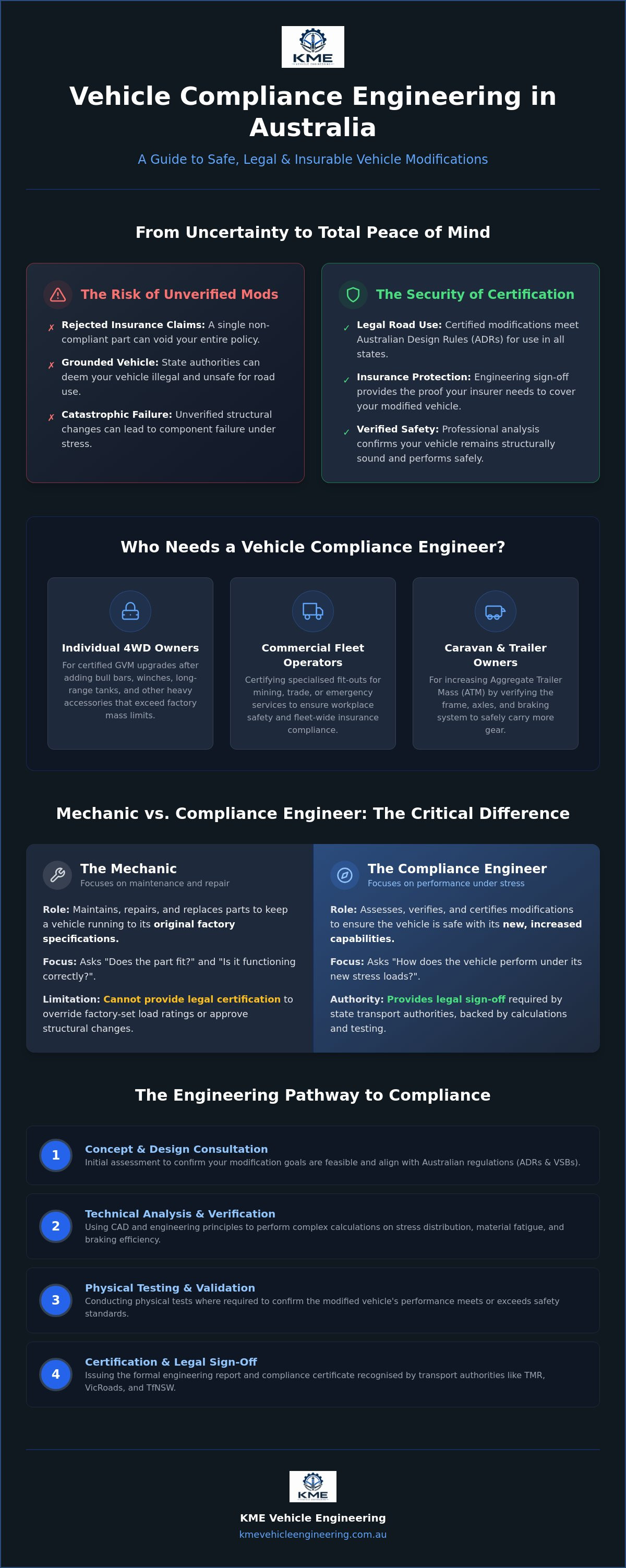
Achieving a road-legal status for a modified vehicle is a methodical journey that begins long before any physical work commences. A vehicle compliance engineer Australia follows a structured five-step workflow to ensure every change is structurally sound and ADR-compliant. This sequence moves from theoretical validation to real-world performance testing, providing a transparent path for both individual owners and commercial fleet managers.
Step 1: Initial Consultation and Feasibility Study. We assess your build goals against current regulations to determine if the proposed modifications can actually be certified.
Step 2: Design and Engineering Calculations. Using Computer-Aided Design (CAD) and Finite Element Analysis (FEA), we perform stress analysis on components to prove safety before they are manufactured.
Step 3: Physical Modification and Inspection. The engineer monitors the quality of the work during the build phase to ensure it adheres to the approved design and welding standards.
Step 4: Performance Testing. This involves rigorous assessments, including braking efficiency tests, lane-change manoeuvres, and weigh-bridge verification to confirm the vehicle handles safely under its new load.
Step 5: Final Sign-off and Certification. Once the vehicle passes all tests, we issue the modification plate or engineering certificate required for registration.
Why Consultation Should Happen Before You Pick Up a Spanner
Engaging a vehicle compliance engineer Australia at the conceptual stage is the most effective way to avoid wasting time and capital on 'un-certifiable' modifications. We often see owners who have invested thousands in parts that simply cannot meet the structural requirements of VSB14 or VSB6. By involving an expert early, we can suggest safer, more efficient ways to achieve your load-carrying or performance goals. For commercial fit-outs, this early involvement is a critical cost-benefit exercise that ensures the final asset is fit for purpose and legally protected from day one. You can start your project on the right track by booking a professional engineering consultation to review your build plans.
Testing and Analysis: Proving the Engineering
The core of the certification process lies in objective data. For heavy vehicles and long combinations, we conduct 'Swept Path Analysis' to ensure the vehicle can navigate standard road turns without encroaching on other lanes. Braking efficiency tests are equally vital; we must prove that an upgraded GVM hasn't compromised the vehicle's ability to stop within the distances mandated by the ADRs. We also perform structural assessments of mounting points for commercial equipment, such as cranes or heavy-duty service bodies. This rigorous testing ensures that your vehicle isn't just 'legal' on paper, but is genuinely safe to operate in demanding Australian conditions.
Why Choose a Specialist Compliance Engineer for Your Build?
Selecting the right vehicle compliance engineer Australia relies on finding a partner who balances technical mastery with a genuine enthusiasm for non-standard challenges. Many engineering firms prefer high-volume, repetitive tasks. At KME Vehicle Engineering, we thrive on the complex puzzles that others might avoid, whether it's a bespoke commercial fit-out or a highly modified touring rig. This focus on intricate GVM and GCM upgrades gives our clients a competitive edge, ensuring that even the most ambitious builds remain grounded in structural reality and legal safety.
Beyond the immediate greater confidence, professional certification is a critical financial safeguard. A modified 4WD with a recognised mod plate and university-trained engineering sign-off maintains a significantly higher resale value. Prospective buyers and dealerships view a certified vehicle as a verified asset rather than a legal liability. It proves the modifications were executed to a professional standard, protecting your investment and ensuring a smoother transition when it's time to upgrade your vehicle.
Expertise in Modern Platforms: 300 Series and Beyond
Modern vehicle platforms are significantly more sophisticated than their predecessors. They rely on integrated safety systems like Electronic Stability Control (ESC) and Autonomous Emergency Braking (AEB) that are calibrated to factory weight and height parameters. When we design and certify suspension kits for vehicles like the 300 Series LandCruiser, we ensure these modifications integrate seamlessly with factory electronics. A standard bolt-on lift might trigger sensor errors or compromise safety interventions. Our precision-engineered approach ensures that your structural repairs and upgrades enhance the vehicle's capability without defeating the advanced safety technology you rely on.
Supporting Commercial Fleets and Industry
For commercial operators, vehicle compliance is also a fleet-governance and work-health-and-safety consideration. If a vehicle is operated above an applicable mass limit or without required approval documentation, the organisation may face regulatory, safety and commercial consequences. KME provides engineering documentation for multi-vehicle fit-outs to support the applicable approval process and internal fleet controls. By partnering with a vehicle compliance engineer Australia trusts, fleet managers can ensure every asset in their stable is safe, legal, and fit for purpose. To secure the future of your build, Contact KME Vehicle Engineering for professional certification today.
Common compliance pitfalls when doing vehicle modifications
Tyre size and lift combinations that exceed limits
Steering/suspension geometry changes without supporting evidence
Brake performance concerns after weight increases
Load ratings not matching the upgraded GVM
Incomplete documentation for components or installation
How to reduce risk before you spend money
Confirm the end goal (towing, payload, mining spec) before choosing parts
Use reputable kits with clear documentation
Keep receipts, part numbers, and install details
Book an engineering consult early—before final fitment
Secure Your Build with Professional Engineering Sign-off
Navigating the complexities of Australian vehicle regulations doesn't have to be a source of confusion. By prioritising university-trained oversight, you ensure your modifications are safe, legal, and structurally sound. Whether you're managing a commercial fleet or preparing a 300 Series LandCruiser for a remote expedition, a qualified vehicle compliance engineer Australia provides the technical verification required to satisfy both insurers and transport authorities. This certification is the final, essential step in transforming an ambitious design into a road-legal reality.
As specialists in GVM, GCM, and ATM upgrades, we offer the expert 300 Series LandCruiser suspension solutions and professional VSB6 and VSB14 certification your build demands. Ensure your vehicle is safe and legal-book an engineering consultation with KME Vehicle Engineering today.
Your next adventure or commercial project deserves the security of a steady hand and a verified solution. We look forward to helping you solve your most complex engineering puzzles with precision and care.
Frequently Asked Questions
What is an automotive engineering certificate and why do I need one?
An automotive engineering certificate documents an engineer's assessment of a modification against the applicable technical and jurisdictional requirements. Depending on the modification and registration jurisdiction, engineering certification may form part of the approval process. It does not by itself guarantee registration, legality or insurance coverage; modifications should also be disclosed to the insurer where required.
Can any mechanic provide vehicle compliance engineering services?
No, a standard mechanic cannot provide engineering certification. While a mechanic is skilled at repairing and maintaining vehicles to factory specifications, a vehicle compliance engineer Australia wide must hold specific tertiary qualifications and be registered as an authorised signatory with state transport authorities. Only these specialists have the legal authority to perform the complex calculations and testing required to certify that a modification is safe and compliant.
Is a GVM upgrade legal if I don't have an engineering sign-off?
A GVM upgrade is not legally recognised until it has been certified by a qualified engineer and fitted with a modification plate. Simply installing heavier springs does not change the legal load rating of your vehicle in the eyes of the law. Driving a vehicle that exceeds its factory mass without an engineered certification means you are operating an unroadworthy vehicle, which carries significant legal and safety risks.
What is the difference between VSB14 and VSB6?
VSB14 is the National Code of Practice for Light Vehicle Construction and Modification, covering vehicles with a GVM of 4.5 tonnes or less. VSB6 is the equivalent code for Heavy Vehicles over 4.5 tonnes. The primary difference lies in the complexity and rigour of the standards; VSB6 involves more intensive structural requirements for things like wheelbase extensions and heavy-duty crane fitments on commercial trucks.
How much does vehicle engineering certification cost in Australia?
The cost of certification depends entirely on the complexity of the modification. For simple, common changes like a single child restraint anchor point, costs typically range between $660 and $990. For more complex projects that require detailed analysis, stress testing, and performance reporting, such as engine swaps or significant structural changes, certification reports usually start from approximately $1,100 and increase based on the scope of work required.
Will an engineering modification affect my vehicle's manufacturer warranty?
A certified modification will not void your entire vehicle warranty, but the manufacturer is not responsible for any failures caused by the aftermarket parts or the modification process itself. For example, if you install a GVM upgrade, the manufacturer will likely decline warranty claims related to the suspension or affected chassis components. Professional engineering ensures the new components are safe and fit for purpose, providing an alternative layer of structural assurance.
Do I need an engineer for a simple suspension lift kit?
You generally don't need an engineer for a minor suspension lift that stays within the limits defined by VSB14, which is often up to 50mm in many Australian jurisdictions. However, if your lift exceeds these limits or involves changing the suspension geometry or mounting points, a vehicle compliance engineer Australia must assess and certify the build. It is always safer to check the specific height allowances for your state before starting work.
What happens if I drive an overloaded vehicle without a GVM upgrade?
Driving an overloaded vehicle is dangerous and can lead to catastrophic component failure or significantly increased stopping distances. Beyond the physical risks, you face heavy fines and the loss of insurance coverage. Most insurance policies contain clauses that void the contract if the vehicle is operated outside of its legal mass limits, meaning you could be personally liable for all damages in the event of a collision.
Is it legal to change the engine in my car if it's from the same manufacturer?
Changing an engine typically requires an engineering certificate if the new motor was not a factory option for your specific model and year. Even when staying within the same brand, differences in engine weight, power output, and emissions equipment must be assessed. The installation must be verified to ensure the braking and cooling systems can handle the new power plant while still meeting ADR emission requirements.
Are aftermarket LED headlight conversions legal for road use?
Most aftermarket LED "drop-in" bulbs are not legal for road use because they don't meet the strict ADR requirements for beam patterns when fitted to halogen housings. These bulbs often cause excessive glare for oncoming drivers and lack the precise light distribution required for safety. To be legal, you must replace the entire headlight assembly with a certified, ADR-compliant unit designed specifically for LED technology.


Comments