
All you need to know about GVM & GCM upgrades in Western Australia

Updated: Oct 13
We’ve all been there – a casual conversation with another 4Wder, exchanging stories, hearing about where they visited recently, talking about what changes you’d like to make to your rig, and then it hits: they start telling you all about their GVM upgrade… 15 minutes later after you have extracted yourself from the conversation, grieving that period of your life that you will never get back, and you wonder to yourself, where did they get all that information from, and why were their opinions so strong?
After a recent conversation such as the one described above, I thought our readers deserved a little bit less mis-information and a little more truth!

Let’s start with the basics – what do GVM & GCM mean, and why should the average 4WD enthusiast care?
GVM stands for Gross Vehicle Mass, it is maximum amount a vehicle is allowed to carry, the original GVM of a vehicle is defined by the original (first stage) manufacturer.
GCM stands for Gross Combination Mass, it is the maximum amount a vehicle can carry and tow simultaneously, again the original GCM of a vehicle is defined by the original manufacturer.
People should care about these numbers because they are what is used to determine if you are overweight on the roads.
OK, so I have a set GVM & GCM, how do I know what they are?
Your GVM is usually recorded on the compliance plate of a vehicle (pre 2022), or on the Register of Approved Vehicles for a more modern vehicle. Usually the GVM is recorded in the user’s manual as well. Your GCM is usually recorded in the specification sheet for your vehicle, and sometimes in the user manual as well, it is rarely recorded on a sticker or plate on the vehicle.
If you can’t determine the GVM or GCM for your vehicle, then you can contact the vehicle manufacturer, the regulator or an automotive consultant for help.
Once I know my GVM & GCM, how do I know if I am within my limits?
Weigh your vehicle – you can drive over a weighbridge fully loaded (fuel full, water tanks loaded etc.) {~ $50}, or you can contact a mobile weighing service to come to you to complete the service {~ $250}. The major advantage of the mobile weighing service, is you spend time with someone knowledgable regarding weight limits, rules and legislation, they will assist you with advice and hints and tips regarding reducing weight, and give you recommendations with regard to how to load your vehicle safely. The weighbridge option is more of a quick check.
OK, I’ve been weighed and I’m overweight, so what?
There are three distinct credible consequences for being overweight, they are:
· Insurance issues
· Fines
· Safety issues
Firstly insurance, as an engineer, I occasionally am asked to investigate the failure of a vehicle to determine the likely cause (usually a combination, i.e. car and trailer, and usually overloaded). People have insurance to cover them financially when things go wrong, however, if things go wrong and your insurer discovers that you loaded your vehicle over its GVM and/or GCM then this will likely affect your insurance coverage. With some people’s combinations exceeding $200k in value, this is a great risk to take, that can normally be eliminated with minor changes to the vehicle. Additionally, what is the point in paying insurance premiums if your vehicle isn’t covered…
Secondly, throughout Australia enforcement occurs, this is where small teams of vehicle inspectors set up on the side of the road and direct people over a weigh bridge or portable scales, sometimes this is conducted just as an education exercise, other times they issue fines. The fines vary across the country form several hundred dollars to several thousands. Additionally, the enforcement officers can require you to ‘make your rig legal’ before you head off again, this might just mean emptying all of the water from your water tanks, or it could mean organising to have your tow vehicle transported by some other means to your destination. In short if you are picked up overweight on the roads then your trip is probably ruined…
Finally, there’s the safety aspect, an overloaded vehicle can be dangerous on the roads. I rarely come across this as I find people normally have appropriate suspension (or other modifications) installed in their vehicle for the load they are carrying, and they really just need help to gain compliance with the relevant laws, however I have seen instances where this is a genuine risk to the occupants and the other road users. Generally speaking if it looks bad when statically loaded, or moves very poorly compared to a similar vehicle, then things need to change. Braking capacity is also an important factor when considering the safety of a laden vehicle.
I’ve weighed my rig, I’m overweight, I want to fix it – so now what?
There are many options for fixing a weight problem, they are:
· Drop weight – the easiest, and simplest method – do you really need 2 x socket sets or 5 tape measures. The best way to do this properly is to take everything out of your vehicle, and then only put back the things you have used in the past 6 months, you’d be surprised at how much stuff you can live without on the road.
· GVM/GCM Upgrade – in service these things are completed using WA’s new Vehicle Technical Bulletins 180A & 181A.
· Change vehicle – as extreme as this sounds, this is the best option for some people, they have simply outgrown their original vehicle, and it’s time for the next one, this is one of the reasons why you see more American trucks on the road nowadays, if you’ve got a 4.5T van, you need something that can tow it!
Alright, I can’t drop weight anymore, and I can’t afford a new vehicle – tell me more about this GVM/GCM Upgrade Option?
GVM Upgrades have been completed in WA for many years. There’s 2 types:
· A pre-rego SSM upgrade, the suspension is installed prior to you first receiving the vehicle. In order to use this option, you need to know what you’re towing, and carrying even before you purchase the vehicle.
· The post-rego upgrade can occur anytime after first registration.
This table will help you see the pros and cons of each path:
GVM + | Pros | Cons |
Pre-rego SSM
Cost: $5k - $10k | Automatically accepted nationwide for registration in other jurisdictions. | You are limited to choosing a certain ‘kit’ for your build.
You cannot change wheels, tyres, or any suspension components without first consulting the SSM holder and gaining their approval. This can be particularly annoying if you break something (e.g. leaking shocks) in the remote areas of Australia, and you have to get special parts shipped to your location and fitted before you move on. |
Post Rego
Cost: $5k - $10k | You can pick and choose the suspension you want to install. You can adjust it in the future if needed (with approval from your engineer).
You can have specific axle ratings assigned for your vehicle – either through analysis or by installing new axles. | Depending on the jurisdiction you move to, and the amount of your GVM increase, you may need to have the vehicle re-checked for compliance.
|
In Western Australia, eligible light vehicles may be considered for GCM re-rating under VTB-181A, subject to the required technical evidence, approved design and WA Department of Transport and Major Infrastructure acceptance. A GVM upgrade does not automatically increase GCM. A federal Second Stage Manufacture GVM approval does not itself authorise a GCM increase. WA does not permit non-OEM increases to a vehicle’s braked towing capacity (BTC).
GCM + | Pros | Cons |
Pre-rego SSM | Not permitted by WA law. | |
Post Rego (VTB 181A) Cost: $5k - $10k | You can pick and choose the suspension you want to install. You can adjust it in the future if needed (with approval from your engineer). | Depending on the jurisdiction you move to, and the amount of your GCM increase, you may need to have the vehicle re-checked for compliance.
|
Let’s take a couple of examples to explain this further.
Example 1: John the Caravanner
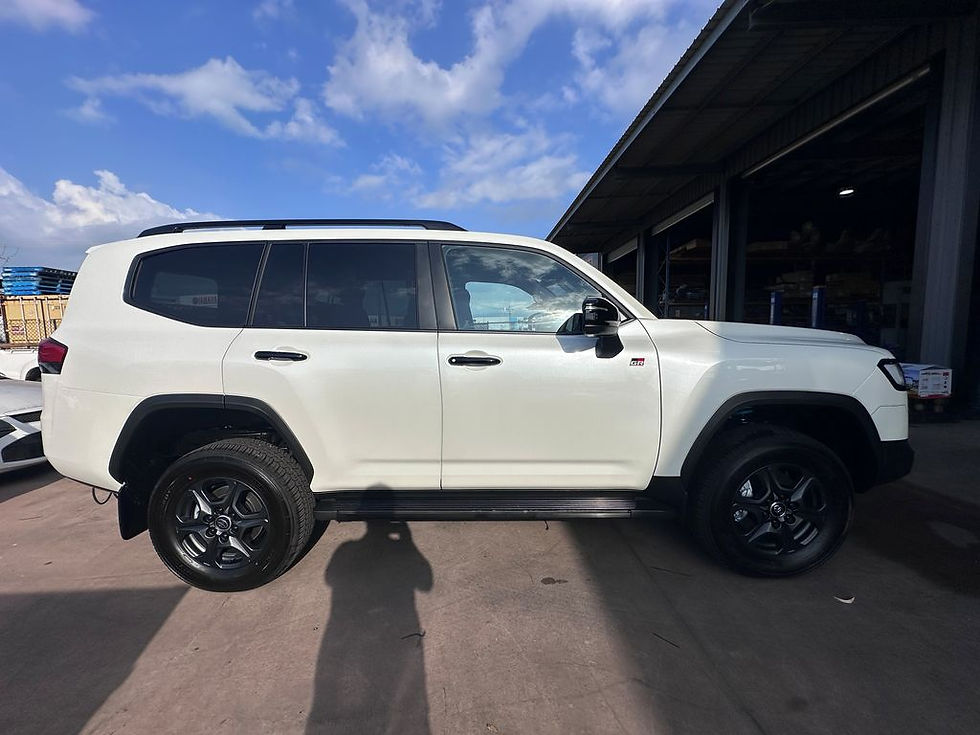
John wants to tow a caravan, he’s in the market for a vehicle and he decides he will purchase a 300 Series LandCruiser – the factory specified values for this vehicle are as follows:
John’s 300 Series LandCruiser
Kerb weight = 2.4T
GVM = 3.28T
Front Axle Rating = 1.63T
Rear Axle Rating = 1.93T
BTC = 3.5T
GCM = 6.78T
He wants the following on/in his vehicle:
· Bullbar
· Roof
rack (flat version)
· Tow kit
· Dual batteries
· Drawer system in the rear
· Fridge & fridge slide in the rear
All of this weighs ~ 300 kg.
John expects the people in his vehicle to weigh a combined amount of 250 kg.
In addition, John expects to load the vehicle with 200 kg worth of luggage, tools and equipment.
He wants to tow a 3.5T Caravan with a 350 kg nose load.
So altogether, the load in and on his vehicle is 300 kg + 250kg + 200 kg + 350kg = 1,100 kg.
This takes his vehicle mass to 2.4T + 1.1T = 3.5T
John needs a GVM Upgrade!
John chooses to purchase a pre-rego SSM GVM Upgrade through a reputable manufacturer, this increases his kerb weight slightly, but also increases his GVM to 4.0T
John’s new specifications are as follows:
Kerb weight = 2.5T
GVM = 4.0T
Front Axle Rating = 1.74T
Rear Axle Rating = 2.36T
BTC = 3.5T
GCM = 6.78T
John purchases his vehicle and when he picks it up, it already has the upgraded GVM.
***
John knows his van will weigh 3.5T fully loaded, and so his combined mass is estimated to be:
3.6T + 3.5T = 7.1T
John needs a GCM Upgrade!
For this illustrative example, John would need to confirm that a suitable WA-approved GCM re-rating design exists for the exact vehicle variant, that the vehicle and installation meet VTB-181A, and that the required WA approval is obtained. The example is not evidence that a 7.5-tonne GCM is available for every 300 Series LandCruiser.
A 7.5-tonne GCM is used here as a hypothetical approved outcome only; the actual permitted GCM depends on the specific vehicle, design evidence, installation and WA approval.
John’s final specifications are as follows:
Kerb weight = 2.5T
GVM = 4.0T
Front Axle Rating = 1.74T
Rear Axle Rating = 2.36T
BTC = 3.5T
GCM = 7.5T
With the required modifications, engineering evidence and WA approvals in place, John could operate within the revised ratings, provided actual vehicle, axle, trailer and combination masses remain within all applicable limits. Insurance coverage depends on the policy terms and circumstances; certification does not guarantee a claim will be accepted.
Example 2: Sally the Caravanner
Sally tows a caravan, she currently owns a 300 Series LandCruiser & a 3.5T van – the factory specified values for her vehicle are the same as John’s vehicle. Sally has all the same additions as John’s except she does not yet have modified suspension. Sally is overloaded when towing.
Sally needs a GVM Upgrade!
Additionally Sally knows that she is also exceeding her GCM.
Sally needs a GCM Upgrade!
Sally would need an eligible vehicle, a suitable approved design and an authorised installation meeting the relevant WA requirements under VTB-180A and VTB-181A. The 4.0-tonne GVM and 7.5-tonne GCM in this example are illustrative and must not be assumed available for every vehicle.
Sally would still need to check her actual loaded vehicle, axle, trailer and combination masses and comply with the conditions of any approval. An upgrade does not guarantee insurance coverage or eliminate all compliance risks.
Those examples really helped explain it. What should people do if they think they’re in a similar situation to John or Sally, or they need more help?
The simplest answer to this is to seek help – try your local 4WD company, or your local automotive consultant. Read what you can from Department of Transport website. If something seems too good to be true, it probably is.
Any final tips for people travelling the roads in Australia?
Take your time, enjoy yourself, take less gear with you. I rarely here stories from people about how their trip was ruined because they didn’t have Starlink. I regularly here stories from people who wish they would head out more often.
Most road incidents involve the big 4: Driving tired, under the influence of drugs or alcohol, speeding or not wearing seatbelts, avoiding these things should take priority.
Comments