
Project Spotlight: RAM 2500 GVM Upgrade to 5,462 kg — Suspension, Rear-Axle FEA & Brake Testing

Updated: 3 days ago
RAM 2500 owners often look at a GVM upgrade when accessories, occupants, fuel, towing equipment and touring gear start consuming the available payload. This Queensland KME Vehicle Engineering project involved engineering assessment for a RAM 2500 at a proposed 5,462 kg GVM, with the assessment extending beyond the mass figure itself.
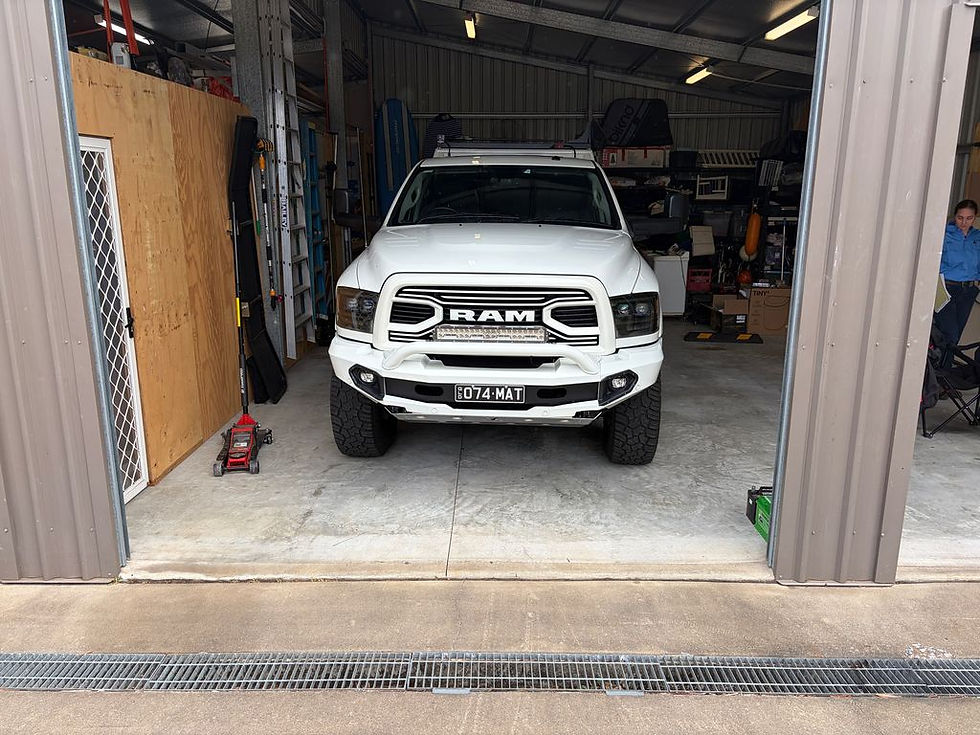
The vehicle and modification package
The project vehicle was a RAM 2500 fitted with several modifications that affected the engineering assessment, including 35 × 12.5 R18 LT tyres, Carli suspension springs, King performance shock absorbers, Air Lift LoadLifter 7500 XL auxiliary rear air springs and an aftermarket Titan long-range fuel tank.
The non-standard tyre and wheel configuration increased overall tyre diameter and width and altered wheel track, so the wheel and tyre changes were assessed as part of the broader vehicle modification rather than treated separately.
Rear axle capacity and finite element analysis
A key part of the proposed GVM increase was the rear axle assessment. KME's engineering evidence records a proposed rear axle rating increase from 3,289 kg to 3,700 kg, supported by additional engineering assessment including finite element analysis. The front axle rating remained at the original manufacturer's rating.
This matters because a higher GVM cannot be justified by suspension changes alone. The relevant axle, suspension, wheel, tyre, braking and structural capacities need to support the proposed operating mass.

Suspension engineering
The modified suspension combined Carli springs and King dampers with LoadLifter 7500 XL auxiliary rear air springs. The engineering assessment considered the load paths, suspension geometry, component suitability, suspension travel and the role of the auxiliary air springs in supporting the primary rear suspension.
The air springs do not independently establish the permissible rear axle load. The certified or assessed vehicle remains limited by the applicable axle, wheel, tyre, brake, suspension attachment and structural capacities.
Brake testing at the revised rating
The brake system itself was not modified, but because the vehicle rating was changing, the brakes were re-tested. KME's engineering evidence records an abridged brake test against the applicable commercial-vehicle braking requirements as part of the GVM assessment.

VSB 6 engineering scope
The controlled engineering evidence identifies the relevant VSB 6 areas as D3 for non-standard rear wheel components, E3 for non-standard front wheel components, F1 for suspension substitution, G4 for brake-system certification, S1 for GVM/GCM re-rating and S2 for GVM re-rating design. The project evidence also records assessment of the long-range fuel tank under M1.
The exact modification codes and approval pathway depend on the vehicle, its existing approval basis, the proposed end state and the registration jurisdiction. Engineering assessment and certification should not be confused with registration-authority acceptance.
The proposed outcome
For this vehicle, the engineering scope was developed around a proposed 5,462 kg GVM and a 3,700 kg rear axle rating, supported by vehicle-specific suspension, wheel and tyre, rear-axle and brake evidence. Those figures apply to this assessed RAM 2500 configuration and should not be assumed to apply to another vehicle without engineering review.
Planning a RAM 2500 GVM upgrade?
KME Vehicle Engineering assesses RAM 2500 GVM upgrades and related heavy-vehicle modifications, including suspension changes, wheel and tyre changes, axle capacity, braking and other vehicle-specific engineering requirements. Send us the vehicle year, current GVM and GCM, suspension and tyre configuration, proposed operating mass and registration jurisdiction so the appropriate engineering scope can be established before major components are purchased or fitted.

Comments