
300 Series LandCruiser Suspension Kit: The Engineering Guide to Performance and Compliance

Updated: 4 days ago
The LC300’s available payload varies by variant and configuration. Accessories, occupants, fuel, cargo and tow-ball download all consume that capacity, so the actual vehicle should be weighed and checked against its GVM and axle ratings before a suspension or GVM package is selected.
A suspension package may form part of an upgrade, but it does not by itself change the vehicle’s approved mass. The available pathway, required components, evidence and final acceptance depend on the exact vehicle, target rating and registration jurisdiction.
This guide explains how to increase your payload capacity while maintaining a level ride height and factory-like handling. We will cover the technical requirements for GVM upgrade options depend on the vehicle, approved pathway and configuration, the essential ADR-compliant lighting modifications, and the process of securing a valid engineering certificate for total greater confidence on the road.
Table of Contents
GVM and GCM: separate ratings and approval pathways
The 300 Series Payload Challenge: Why Factory Suspension Falls Short
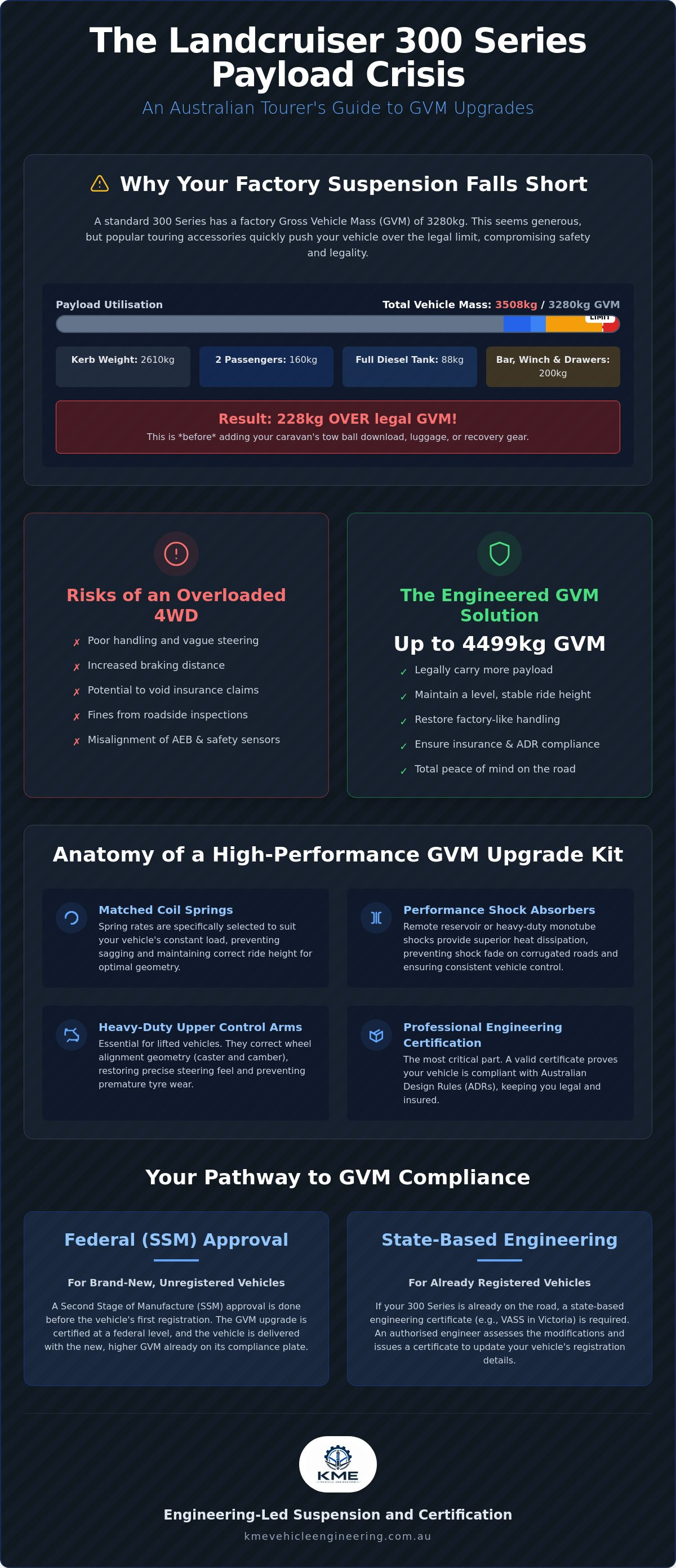
The 300 Series is the most technologically advanced iteration in the Toyota Land Cruiser series history, but its factory capacity remains a significant hurdle for Australian tourers. While the V6 twin-turbo diesel provides immense torque for towing, the legal payload is often exhausted before the vehicle even leaves the showroom floor. A standard 300 Series LandCruiser suspension kit from the factory is tuned primarily for unladen comfort, which leads to significant rear-end sag and front-end "diving" once real-world touring equipment is installed.
When you add a steel bullbar, a high-mount winch, and a rear drawer system, you aren't just adding weight; you're fundamentally shifting the vehicle's centre of gravity. This physical change directly impacts the 300 Series' complex safety suite. If the vehicle's rake is altered by heavy accessories, the radar and camera sensors for Autonomous Emergency Braking (AEB) and Lane-Keep Assist can become misaligned. This isn't merely a matter of aesthetics or ride quality; it's a compromise of the vehicle's active safety systems that requires a precise engineering solution to rectify.
Understanding the Factory GVM Limits
Many LC300 variants list a manufacturer GVM of 3,280 kg, but kerb mass and resulting payload vary by variant, options and fitted accessories. Confirm the applicable manufacturer data and weigh the completed vehicle.
The Dangers of an Overloaded 4WD
Operating above an applicable mass or axle limit can create regulatory, safety and insurance issues. Keep the vehicle within its approved ratings, disclose relevant modifications to the insurer and obtain written confirmation of cover and conditions.
Gross Vehicle Mass (GVM) is defined under Australian Design Rules as the maximum legal weight of a vehicle when fully loaded, including all occupants, fluids, accessories, and cargo.
Relying on a generic "lift kit" won't solve these compliance issues. A true engineered solution provides the verified data and certification required to prove your vehicle remains within legal bounds, ensuring you have total greater confidence during remote expeditions or heavy towing tasks.
Key Components: What Actually Makes a High-Performance 300 Series Kit?
A high-performance 300 Series LandCruiser suspension kit is a complex assembly of engineered parts designed to work in unison. It's not enough to simply increase height; the system must manage the massive kinetic energy of a vehicle traversing uneven terrain while maintaining strict legal compliance. Every component, from the valving in the shocks to the wire diameter of the coils, must be selected based on the specific weight and intended use of the vehicle.
Focusing solely on lift height without considering component synergy is a common mistake that leads to poor handling and potential mechanical failure. A professional-grade kit addresses the primary suspension elements while simultaneously correcting the secondary geometry changes that occur when a vehicle is raised. This holistic approach ensures that the 300 Series remains stable at highway speeds and predictable in emergency braking scenarios.
Remote Reservoir vs. Monotube Shocks
remote-reservoir shock absorbers can be appropriate for some high-demand applications for heavy-duty Australian touring. Unlike standard monotube designs, these units feature an external canister that significantly increases oil capacity. This extra volume is critical for heat dissipation during long stretches of corrugated outback roads. When shocks overheat, the oil thins and the damping force fades, leading to a dangerous loss of vehicle control. High-end kits often include adjustable damping, allowing you to firm up the ride for highway towing or soften it for low-speed work in the bush. These components are built for longevity and are typically serviceable, providing a much higher return on investment over the life of the vehicle.
Correcting Suspension Geometry
Spring, damper, control-arm and lateral-location requirements are vehicle- and lift-specific. Geometry-correction components may be required after measurement; no single component is automatically necessary for every LC300.
GVM and GCM: separate ratings and approval pathways
A GVM increase requires an applicable pre-registration or in-service approval pathway. Installing a suspension kit alone does not change GVM. A GVM upgrade does not automatically change GCM, towing capacity or axle ratings. Any proposed change to another rating requires a separate assessment and may not be available.
The Engineering Certification Process
Engineering and modification documents provide evidence of the assessed configuration. The applicable authority determines final acceptance and registration treatment. Owners should separately disclose modifications to their insurer.
GVM vs GCM: What You Need for Towing
GVM and GCM are separate ratings. A GVM upgrade does not automatically change GCM or towing capacity. Any proposed change requires its own vehicle- and jurisdiction-specific assessment and may not be available.
Selecting Your Setup: Matching Suspension to Your 4WD Usage
Choosing a 300 Series LandCruiser suspension kit is not a one-size-fits-all process. Your selection should be dictated by how the vehicle spends 90% of its time, rather than a "worst-case scenario" that rarely occurs. Installing heavy-duty springs designed for a constant 600kg load on a vehicle that usually drives empty will result in a harsh, skittish ride and poor traction on corrugated surfaces. Conversely, under-springing a dedicated tourer leads to the safety system misalignments and "bottoming out" issues we identified earlier.
We categorise 300 Series builds into three primary profiles to help owners navigate these choices:
The Weekend Warrior: Prioritises unladen ride quality and highway comfort. This setup usually involves a 50mm lift with lighter spring rates, perfect for daily commuting and occasional beach work or light camping trips.
The Remote Tourer: Engineered for reliability in the bush. These kits focus on heat management through remote reservoir shocks and constant-load springs that account for rear drawers, a fridge, and long-range fuel tanks.
The Heavy Towing Specialist: Designed specifically for those pulling 3.5-tonne caravans. The focus here is on rear-end stability and maximising GCM to ensure the vehicle remains level and predictable when the tow ball download is applied.
It is vital to factor in your future modifications now. If you plan to add a rear bar or a roof rack in six months, choosing springs based on your current weight will only lead to a second purchase later. We recommend selecting a spring rate that matches your final intended build weight.
Weight Calculation 101
Don't guess your vehicle's weight. The only way to accurately select a 300 Series LandCruiser suspension kit is to visit a public weighbridge. You need to account for "hidden" weight that many owners overlook. This includes a full tank of diesel (roughly 80kg), a full water tank, all passengers, and even the family dog. Once you have your actual front and rear axle weights, you can select a spring rate that keeps the shock absorbers operating within their ideal stroke range. If you need assistance interpreting your weighbridge results, you can contact our engineering team for a technical consultation to ensure your hardware matches your mass.
Lift Height vs. Practicality
Lift-height limits and approval requirements vary by jurisdiction and by the combined effect of suspension, tyres and other changes. Confirm the applicable pathway before selecting components.
Pre-registration vs Post-registration certification
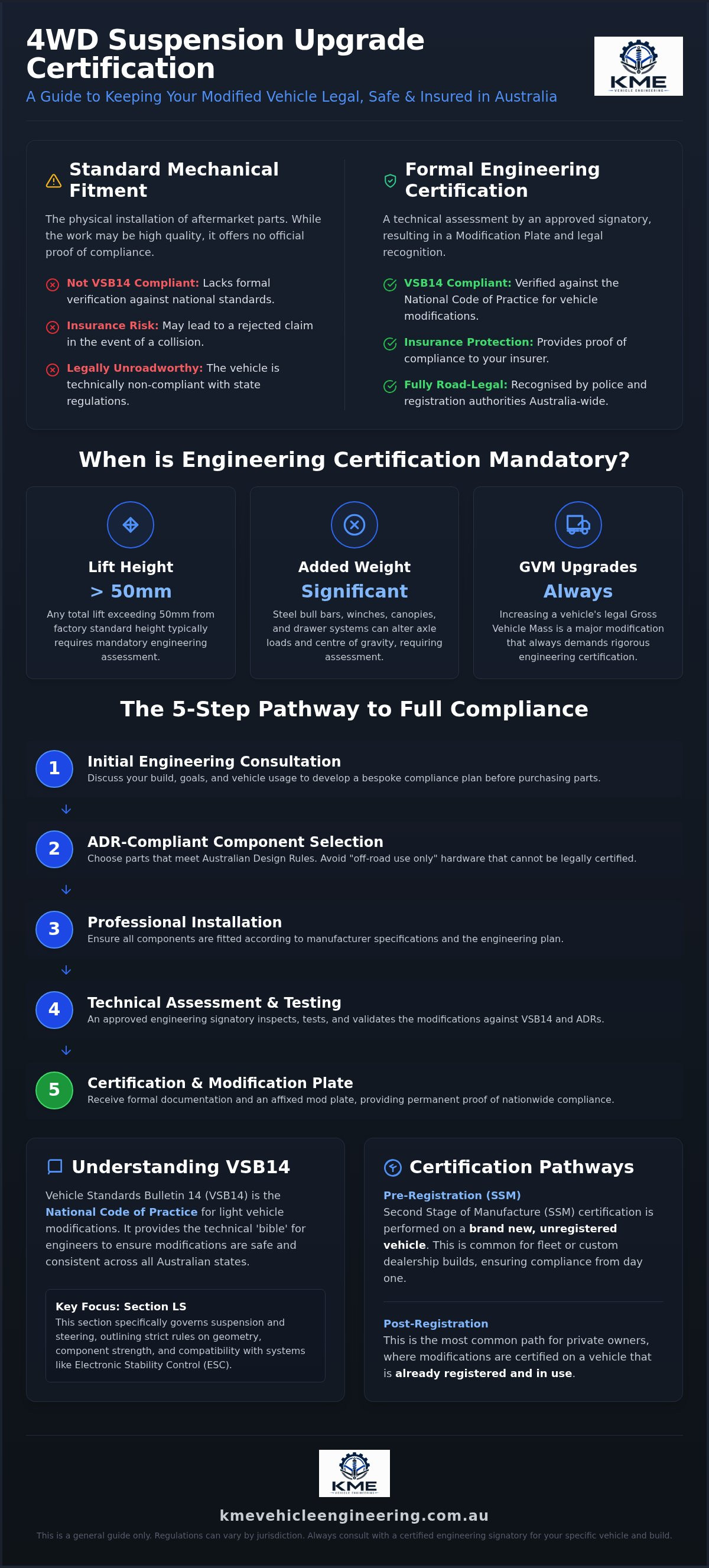
Second Stage Manufacture is a Commonwealth approval pathway for eligible new vehicles before first registration. In-service modifications are administered under the applicable state or territory pathway. Signatory eligibility, inspection, documentation and recognition of interstate evidence must be confirmed for the registering jurisdiction.
Dynamic Stability Testing (The Lane Change Test)
Dynamic stability or other testing may be required where the applicable code, authority or engineering assessment calls for it. The test method, threshold and acceptance criteria are configuration- and jurisdiction-specific.
The KME Difference: Engineering-Led Suspension and Certification
At KME Vehicle Engineering, we view a 300 Series LandCruiser suspension kit as one component of a larger regulatory puzzle. While many retailers focus solely on the aesthetic of a lift, Daly Kelly and our engineering team prioritise the technical mastery required to keep your vehicle within legal bounds. We start with compliance because we understand that an uncertified modification is a liability, not an upgrade. Our background in structural assessment allows us to solve the complex engineering challenges that standard workshops often avoid, such as managing the specific chassis stresses inherent in the modern LandCruiser platform.
Our capability extends far beyond the installation of hardware. We provide certified structural repair plans and comprehensive chassis assessments for vehicles that have already been pushed to their limits in remote environments. This engineering-led approach ensures that every modification we sign off is backed by rigorous data and verification. We provide national coverage for vehicle modification certification and reports, with the engineering scope and certification pathway matched to the vehicle, modification and relevant jurisdiction.
Comprehensive Compliance Inspections
During a vehicle modification sign-off, KME conducts a methodical inspection of all critical safety systems. We verify that your 300 Series meets the applicable engineering and certification requirements for the proposed configuration, from brake performance to the correct alignment of active safety sensors. A professional engineering certificate does more than satisfy regulatory authorities; it provides documented evidence of the approved modification. Prospective buyers in the 300 Series market are increasingly savvy about weight limits, and having a verified GVM upgrade plate provides the ultimate greater confidence that the vehicle has been modified correctly and safely.
Beyond Suspension: Commercial and Fleet Solutions
Commercial operators working in harsh environments require a different level of durability and precision. We specialise in fit-outs for commercial 300 Series fleets, where constant heavy loads and punishing terrain are the daily reality. Our team develops chassis and structural repair plans to extend the service life of these vehicles, ensuring they remain productive and safe under extreme conditions. Whether you are a solo tourer or a fleet manager, the path to a compliant, high-performance build starts with a professional assessment. You can organise your 300 Series engineering consultation with KME today to ensure your vehicle is as capable as it is legal.
Securing Your 300 Series Build for the Long Haul
Transforming your vehicle into a capable outback tourer requires moving beyond basic modifications toward a holistic engineering approach. We have explored how the factory 3280kg limit quickly vanishes under the weight of essential accessories and why a high-quality 300 Series LandCruiser suspension kit must address geometry correction alongside load capacity. By prioritising structural integrity and thermal management in your shock absorbers, you ensure your LandCruiser performs predictably whether you're traversing corrugated tracks or towing a heavy caravan on the highway.
A documented engineering assessment can support the applicable modification and registration process. It does not guarantee authority acceptance, road-use legality, warranty treatment or insurance cover.
Frequently Asked Questions
Do I need an engineering certificate for a 2-inch lift on my 300 Series?
Not always. Whether a nominal 50 mm suspension lift requires certification depends on the jurisdiction, the vehicle and the combined effect of tyres and other modifications. A lift used as part of a GVM upgrade follows the applicable GVM approval pathway.
What is the difference between a GVM upgrade and a GCM upgrade?
GVM and GCM are separate ratings. A GVM upgrade does not automatically change GCM or towing capacity. Any proposed change requires its own vehicle- and jurisdiction-specific assessment and may not be available.
Will a suspension kit affect my 300 Series LandCruiser warranty?
Aftermarket modifications may affect warranty claims relating to modified components or resulting damage. Warranty terms and Australian Consumer Law rights depend on the circumstances; confirm the position with Toyota, the component supplier and installer.
Can KME certify a suspension kit I have already installed?
KME can assess an already-modified vehicle, but certification is not automatic. Eligibility depends on the components, installation, evidence, condition, target rating and jurisdiction. Rectification or additional testing may be required.
How much extra payload can I legally get with a 300 Series GVM upgrade?
Available target GVM and resulting payload depend on the exact variant, approval pathway, axle and component capacities and final tare mass. KME should confirm the applicable target before any numerical increase is published or relied upon.
What happens if I am caught driving an overloaded vehicle without an upgrade?
Operating above an applicable mass or axle limit may result in enforcement action and may affect insurance. Keep the vehicle within its approved ratings and confirm insurance conditions directly with the insurer.
Is a GVM upgrade valid across all Australian states and territories?
SSM and in-service approvals are different pathways. Registration and treatment of modification evidence are administered by the relevant authority. Confirm requirements before transferring or re-registering a modified vehicle in another jurisdiction.
Do I need to upgrade my brakes when installing a GVM suspension kit?
Brake requirements are vehicle- and target-rating-specific. Required evidence may include assessment, calculation or testing. Component changes should not be stated as required or unnecessary until the proposed configuration is assessed.
Comments