
4x4 Modification Laws Western Australia: The 2026 Engineering Compliance Guide

Updated: Sep 9
That aggressive suspension lift and oversized tyre setup might look the part on the tracks, but without the right paperwork, it is a significant legal liability. You have likely invested heavily in your vehicle to prepare it for the WA outback, and the last thing you need is a defect notice or a denied insurance claim because of a compliance oversight. Understanding the 4x4 modification laws Western Australia enforces is often a confusing process, especially when trying to reconcile national standards with specific Department of Transport regulations.
We recognise that you want a vehicle that performs reliably without the constant anxiety of a roadside inspection. This guide provides the technical clarity you need to ensure your modifications are not only legal but structurally sound and fully certified. We will examine the 50mm combined lift and tyre limit, explain the critical difference between simple and complex modifications, and outline the precise steps required to secure an engineering certificate that protects your investment and your safety.
Table of Contents
Understanding the WA Vehicle Modification Framework
The regulatory landscape for Car tuning and vehicle customisation in WA is structured to maintain road safety while allowing for functional improvements. At the top of the hierarchy are the Australian Design Rules (ADR), which set the national standards for safety and emissions. These are supported by the National Code of Practice, or VSB14, which provides a technical baseline for modifications. However, the 4x4 modification laws Western Australia follows are ultimately governed by the Department of Transport (DoT) under the Road Traffic (Vehicles) Regulations 2014. This means WA often has specific interpretations that might differ from other states.
The DoT categorises modifications into three distinct levels: minor, simple, and complex. This classification determines whether you can simply bolt an accessory on or if you need a formal engineering assessment. Central to these rules is the preservation of safety systems like Electronic Stability Control (ESC) and braking efficiency. Modern vehicles rely on complex sensors. Any change to the vehicle's height or weight distribution can compromise these systems. An authorised modifier provides the technical design and certification for these changes, whereas an Approved Inspection Station (AIS) typically verifies the roadworthiness of simpler modifications or standard vehicle transfers.
Minor Modifications: What Doesn't Require Inspection
Minor modifications are generally those that do not affect the structural integrity or essential safety systems of your 4WD. This includes fitting a snorkel, a roof rack, or an ADR-compliant bull bar. While these don't require a formal inspection, they must still meet specific safety criteria. For instance, fishing rod holders must not protrude forward of the bull bar or block the driver's view. Additional lighting, such as spotlights or LED bars, must be fitted in pairs and wired to operate only with high-beam headlights. If an accessory is poorly fitted and obstructs an airbag sensor or compromises pedestrian safety, it becomes a legal liability regardless of its status as a minor change.
Complex Modifications and Engineering Sign-off
When a modification alters the vehicle's chassis, suspension geometry, or weight-carrying capacity, it is classified as complex. This is where professional engineering becomes mandatory. Significant suspension lifts, GVM upgrades, and the installation of long-range fuel tanks all fall into this category. Because these changes fundamentally alter how a vehicle handles in an emergency, the DoT requires a certified vehicle modification engineer to sign off on the work. Engineering assessments involve a detailed technical review to verify that the vehicle remains compliant with ADRs. Unlike a standard AIS inspection, an engineering certification provides the structural verification needed for high-stakes modifications.
Lift Kits, Tyres, and the 50mm Rule
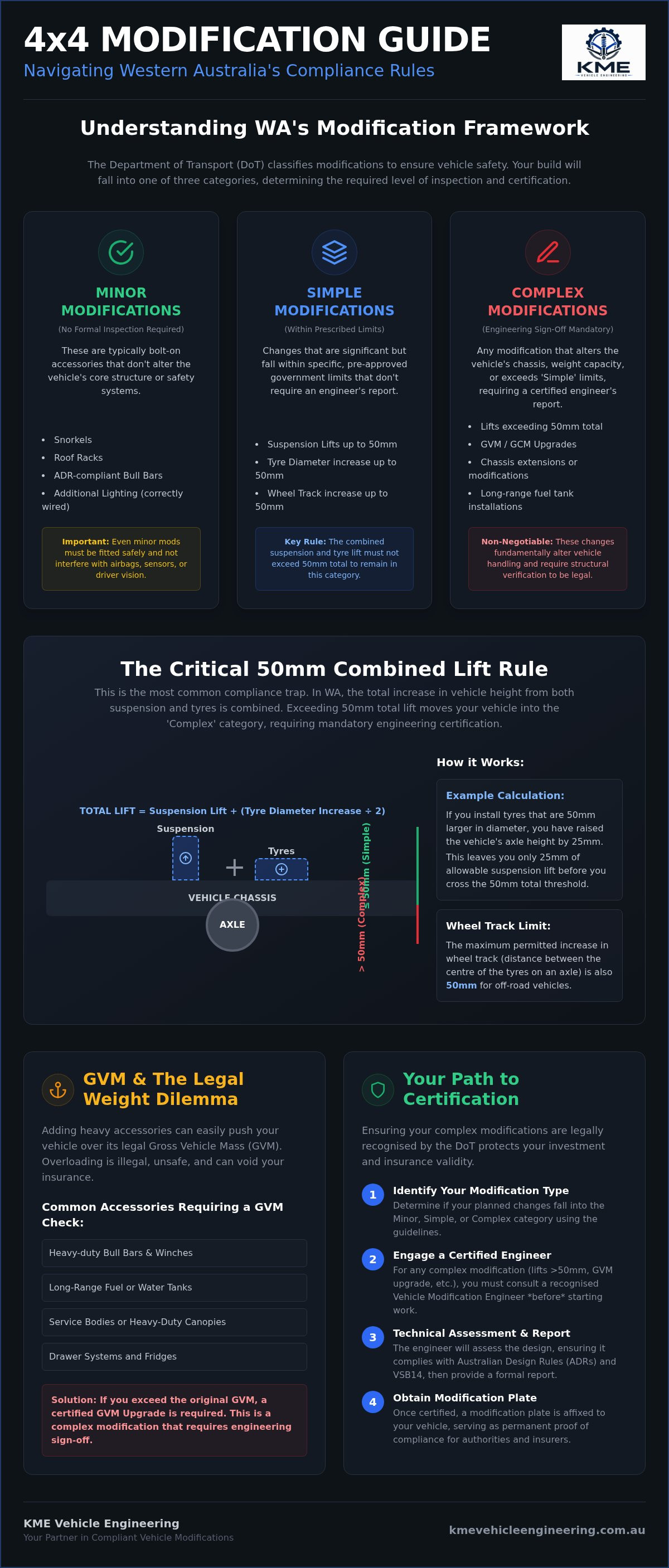
Achieving the perfect stance for your 4WD involves a careful balance between ground clearance and legal compliance. Under the 4x4 modification laws Western Australia enforces, the most critical figure to remember is 50mm. This is the maximum combined increase in vehicle height permitted through suspension and tyre modifications before formal engineering certification becomes mandatory. If you increase your tyre diameter by 50mm, you have effectively raised the vehicle by 25mm. This leaves only 25mm of allowable suspension lift before you exit the 'simple modification' category. Exceeding the applicable simple-modification limits without the required approval may expose the vehicle to a defect or compliance issue and may also affect insurance depending on the policy and circumstances.
Wheel track modifications are equally regulated to ensure vehicle stability isn't compromised. You are generally permitted to increase the wheel track by a maximum of 50mm for off-road vehicles. This measurement is taken from the centre of the tyre on one side to the centre of the tyre on the other. While wider offsets improve stability, they also increase stress on wheel bearings and steering components. For comprehensive details on these technical limits, the Department of Transport provides specific guidelines on Modifying a vehicle in Western Australia to ensure road users remain safe.
Tyre Size and Speedometer Accuracy
Fitting larger rubber isn't just about clearance; it's about maintaining vehicle telemetry. Your speedometer must remain accurate. If larger tyres cause the speedometer to under-read, recalibration is a legal necessity. Additionally, tyres must maintain a load and speed rating equal to or greater than the original manufacturer's specifications. If your new setup extends beyond the bodywork, you must install mudguards or flares that fully cover the tyre tread to prevent road debris from being flicked at other motorists.
Going High: Certification for Lifts Above 50mm
Navigating 4x4 modification laws Western Australia requires a methodical approach when you decide to go beyond the 50mm combined limit. Engineering for high lifts often requires a lane change test, also known as a swerve test, to prove the vehicle remains stable during emergency manoeuvres. A higher centre of gravity significantly impacts how Electronic Stability Control (ESC) systems intervene. If you are looking for compliant high-performance options, our 300 Series LandCruiser suspension kit is designed to meet these strict standards. If you're unsure if your current setup meets the mark, we recommend booking one of our professional vehicle compliance inspections to verify your build's legality and safety.
GVM, GCM, and the Legal Weight Dilemma
Equipping a modern 4WD for remote travel often leads to an unintended consequence: exceeding the manufacturer’s legal weight limits. Standard accessories like steel bull bars, winches, and dual-battery systems can consume hundreds of kilograms of payload before you even load passengers or recovery gear. Under the 4x4 modification laws Western Australia enforces, staying within your Gross Vehicle Mass (GVM) and Gross Combination Mass (GCM) is not just a matter of performance; it is a legal imperative. GVM refers to the maximum weight of the vehicle itself when fully loaded, while GCM is the total allowable weight of the vehicle and its trailer combined.
Driving an overloaded vehicle can create safety and compliance risks beyond roadside enforcement. If an incident occurs, the vehicle's actual mass, the applicable limits and the circumstances may also be relevant to liability or insurance. To manage those risks, the WA Department of Transport Vehicle Modification Rules provide a clear path for owners to legally increase their weight capacity through professional engineering and certification.
The GVM Upgrade Process
There are two primary paths to increasing your payload: Second-stage manufacturing (SSM) and post-registration engineering. SSM occurs before the vehicle is first registered, whereas post-registration upgrades require an individual engineering certificate. Understanding what is a GVM upgrade is essential for anyone building a touring rig. The process typically involves replacing factory suspension components with heavy-duty springs and shocks designed to manage the increased load safely. In some cases, axle bracing or chassis strengthening plans are required to maintain structural integrity under high stress.
GCM and Towing Capacity Upgrades
The legality of GCM upgrades remains a point of significant discussion within the industry. While some states have restricted these modifications, WA currently allows for GCM increases when supported by comprehensive engineering data and structural assessments. This is particularly relevant for those towing large caravans that require an increase in Aggregate Trailer Mass (ATM) to match the tow rig's capabilities. Ensuring your vehicle and trailer are legally matched requires a steady hand and a deep understanding of mechanical design. We focus on providing verified solutions that ensure your entire combination remains stable and compliant on the road.
GVM: The maximum legal weight of the vehicle, including all accessories and passengers.
GCM: The total combined weight of the tow vehicle and the trailer.
ATM: The total weight of the trailer when it is not hitched to the vehicle.
Payload: The difference between your vehicle's kerb weight and its GVM.
Engineering Certification: When Do You Need a Report?
Complex modifications require more than high-quality components; they need the approval pathway applicable to the vehicle and modification in Western Australia. Where engineering or Department of Transport approval is required, planning that pathway before work begins can reduce the risk of rework or an unsuitable configuration.
The certification journey typically follows these five critical steps:
Consultation: You engage a certified vehicle modification engineer to review your proposed changes. They assess the structural impact and ensure the plan aligns with Australian Design Rules.
Modification Application: A formal application is submitted to the Department of Transport (DoT). Unlike simple changes, complex modifications require DoT approval of the concept before final testing.
Physical Modification: The vehicle is built or altered strictly according to the engineered specifications.
Final Inspection: The engineer performs a physical assessment and necessary testing, such as braking or stability tests, to issue a formal Engineering Certificate or Modification Report.
Licence Update and Plating: Where required by the applicable pathway, Department of Transport records and vehicle identification or modification documentation are updated. The relevant approval records should be retained as evidence of the vehicle's approved configuration.
If you are planning a build that requires professional oversight, our team provides the expert vehicle modification certification services needed to navigate these steps with confidence.
The Role of VSB14 in Western Australia
The National Code of Practice, or VSB14, serves as the primary technical guide for light vehicle modifications in Australia. For 4WD owners, Section LS (Tyres and Suspension) is the most relevant chapter. It outlines the specific engineering requirements for steering geometry and suspension travel. Even if you use 'off-the-shelf' components, a complex build involving multiple changes often requires an engineer to verify that these parts work together safely without compromising the vehicle's original safety systems.
Heavy Vehicle Modifications (VSB6)
When a 4WD is modified to a GVM exceeding 4,500kg, it transitions into the heavy vehicle category. At this point, the engineering requirements shift from VSB14 to the more rigorous VSB6 standards. Understanding vsb6 is vital for commercial operators and heavy fleet customisations. This code governs everything from chassis extensions to major structural repairs. For older rigs or those with previous damage, a certified chassis and structural repair plan is often the only way to return the vehicle to a compliant, safe state on WA roads.
Staying Compliant: Certification for Peace of Mind
Compliance is the final, essential step in any vehicle build. It transitions your 4WD from a project into a legally recognised road-going asset. While the technical side of 4x4 modification laws Western Australia enforces can be dense, the objective is simple: ensuring every change is safe and verified. Proactive certification is the most effective way to avoid a 'Yellow Sticker' or Defect Notice. Once a vehicle is 'stickered', it must undergo a full inspection at an Approved Inspection Station, often requiring the expensive removal of uncertified parts. Addressing these requirements during the build phase saves time and prevents the stress of being grounded by the authorities.
Engineering and approval documentation can also support disclosure of modifications to an insurer and provide a clearer record for a future purchaser. Insurance coverage remains subject to the policy and circumstances, and a modification plate or engineering report does not by itself guarantee an insurance outcome or prove compliance with every regulatory requirement.
Specialised Solutions for the 300 Series LandCruiser
Modern high-tech vehicles require a more sophisticated approach to customisation. The 300 Series LandCruiser, for example, features advanced suspension geometry and integrated safety systems that are highly sensitive to height changes. Generic lift kits often trigger electronic fault codes or compromise the calibration of autonomous emergency braking systems. We provide specialised engineering solutions for these vehicles, ensuring that performance upgrades work in harmony with factory safety tech. This level of precision is especially vital for commercial fit-outs and fleet vehicles that must maintain high safety ratings under heavy operational loads.
Just as advanced vehicles require specialist care, so do the systems that protect them at home; for those in the Melbourne area, you can discover We Do Garage Doors to ensure your garage setup remains secure and functional.
Final Checklist for WA 4x4 Owners
Before you head off on your next trip or commit to a major modification, follow these practical steps to ensure your rig remains compliant:
Confirm your weights: Take your fully loaded vehicle to a public weighbridge to verify your tare weight, GVM, and GCM.
Check ADR compliance: Ensure all accessories, particularly bull bars and auxiliary lighting, meet Australian Design Rules.
Verify tyre coverage: Check that your flares or mudguards fully cover the tyre tread to avoid roadside fines.
Consult an expert: Contact a professional vehicle modification engineer before you start a project to ensure your plan is legally sound.
At KME Vehicle Engineering, we take pride in solving the complex puzzles that standard workshops cannot. Our methodical approach ensures your vehicle is not only capable of tackling the toughest tracks but is also fully compliant with the 4x4 modification laws Western Australia mandates for 2026 and beyond.
Just as a well-engineered vehicle provides peace of mind on the road, a well-structured financial plan provides security for your future; you can learn more about Zenith Wealth to find out how expert advisory services can support your long-term goals.
Secure Your Build with Professional Engineering
Building a capable touring rig involves balancing off-road performance with the modification and mass requirements that apply in Western Australia. Planning the approval pathway early is particularly important for suspension, tyre, GVM and structural changes. Whether you are modifying a 300 Series LandCruiser or managing a commercial fleet, the objective is to produce clear engineering evidence and follow the relevant approval process rather than assume a modification is automatically accepted.
Our team specialises in GVM, GCM, and ATM upgrades, alongside comprehensive vehicle modification certification. We possess the specific expertise required for 300 Series LandCruiser compliance and complex structural repair plans. Don't leave your safety or legal standing to chance by guessing at regulatory standards. Ensure your 4WD is legal and safe with KME Vehicle Engineering. We are here to help you navigate the technical hurdles so you can explore the outback with total confidence.
Frequently Asked Questions
Can I fit 35-inch tyres to my 4WD legally in WA?
Fitting 35-inch tyres is generally only legal if the total diameter increase is within 50mm of the largest optional tyre specified by the manufacturer for your specific model. For most modern 4WDs, a 35-inch tyre represents a significant increase that exceeds this limit, categorising it as a complex modification. You will require an engineering certificate to verify speedometer accuracy and ensure the braking system can manage the increased rolling mass safely.
What is a 'yellow sticker' and how do I get it removed?
A 'yellow sticker' is a formal defect notice issued by the WA Police or Department of Transport when a vehicle is deemed unroadworthy or non-compliant. To remove it, you must rectify all listed faults and pass a full inspection at an Approved Inspection Station (AIS). If the notice was issued for uncertified 4x4 modifications, you must secure a formal engineering report before the AIS can clear the vehicle for road use.
Do I need an engineer for a 2-inch lift kit in Western Australia?
You don't necessarily need an engineer for a 50mm suspension lift if your tyres remain at the factory diameter. However, the 50mm limit applies to the combined lift of both suspension and tyres. If you fit a 2-inch lift plus larger tyres, you have exceeded the simple modification threshold. In this scenario, the 4x4 modification laws Western Australia enforces require a professional engineering sign-off to remain legal.
Is a GVM upgrade legal after the vehicle has been registered?
Yes, a GVM upgrade is legal after registration through the individual engineering certification pathway. While second-stage manufacturing (SSM) applies to new, un-registered vehicles, post-registration upgrades allow owners of used vehicles to increase their payload. This process involves a physical inspection and structural assessment by a certified engineer to update the vehicle’s licence records and fit a new modification plate to the chassis.
Can I increase my towing capacity in WA without an engineering certificate?
No, you cannot legally increase your towing capacity or Gross Combination Mass (GCM) without a formal engineering certificate. Any deviation from the manufacturer’s original towing specifications is classified as a complex modification. It requires a detailed structural assessment of the chassis and tow bar mounting points to ensure the vehicle can safely manage the additional stress of a heavier trailer or caravan combination.
Are bull bars with rod holders legal on WA roads?
Rod holders are legal in WA provided they meet specific safety criteria. They must be fitted so they don't protrude forward of the bull bar's profile or obstruct the driver's view of the road. Most importantly, rod holders should only contain rods while you are actively travelling to or from a fishing location; they are often considered a pedestrian safety hazard if left empty and protruding during daily driving.
Does a modification plate from another state count in WA?
A modification plate from another state is not automatically recognised as valid for a vehicle registered in Western Australia. If you move to WA or purchase an interstate vehicle, the Department of Transport typically requires a local engineering assessment. A WA-based engineer must verify the modifications meet local standards before the vehicle's licence records can be updated and a WA-compliant modification plate is issued.
How do 4x4 modification laws affect my insurance coverage?
Insurance companies generally only provide cover for vehicles that are roadworthy and compliant with state regulations. If you have uncertified modifications that exceed the legal limits, your insurer may deny a claim following an accident or theft. Securing a modification plate ensures your insurer recognises the vehicle as legal and safe, which protects your financial interests and provides peace of mind during your travels.


Comments