
4x4 Handling Problems Under Load: The 2026 Engineering Guide to Safety and Compliance
- Daly Kelly

- 5 days ago
- 12 min read
Did you know that nearly 23% of vehicles stopped during recent police weighbridge operations were found to be over their legal weight limit? Most drivers don't realise they have 4x4 handling problems under load until they're halfway to their destination and the steering feels light, the body roll becomes excessive, or the rear suspension bottoms out on a simple corrugated track. It's a stressful way to travel, especially when you're constantly worried about whether your insurance remains valid while carrying a heavy canopy or towing a caravan.
We agree that your 4WD should feel planted and responsive, regardless of how much gear you've packed for the trip. This guide explains how to resolve these handling issues through certified engineering and GVM upgrades that provide a permanent, legal solution to weight related instability. We'll explore the technical causes of poor vehicle dynamics and outline the specific steps to achieve a compliant rig that meets VSB14 standards. You'll learn how a tailored suspension approach ensures your 300 Series or Hilux handles with precision while keeping your GCM and GVM within safe, legal bounds.
Table of Contents
Common Symptoms of 4x4 Handling Problems Under Load
Identifying 4x4 handling problems under load starts with recognising that your vehicle's factory suspension is an engineering compromise. It is typically designed to provide a supple ride while unladen, which often means it lacks the necessary spring rate to support a permanent touring setup, heavy trade tools, or a high tow-ball download. You'll likely notice the vehicle swaying excessively when changing lanes or feeling "mushy" through corners. If you're frequently hitting the suspension bump stops over minor track undulations or speed humps, your springs have reached their elastic limit. This occurs because the vehicle is operating too close to its maximum Gross Vehicle Mass (GVM), leaving almost no travel for the dampers to control the moving mass.
The Dangerous "Light" Steering Phenomenon
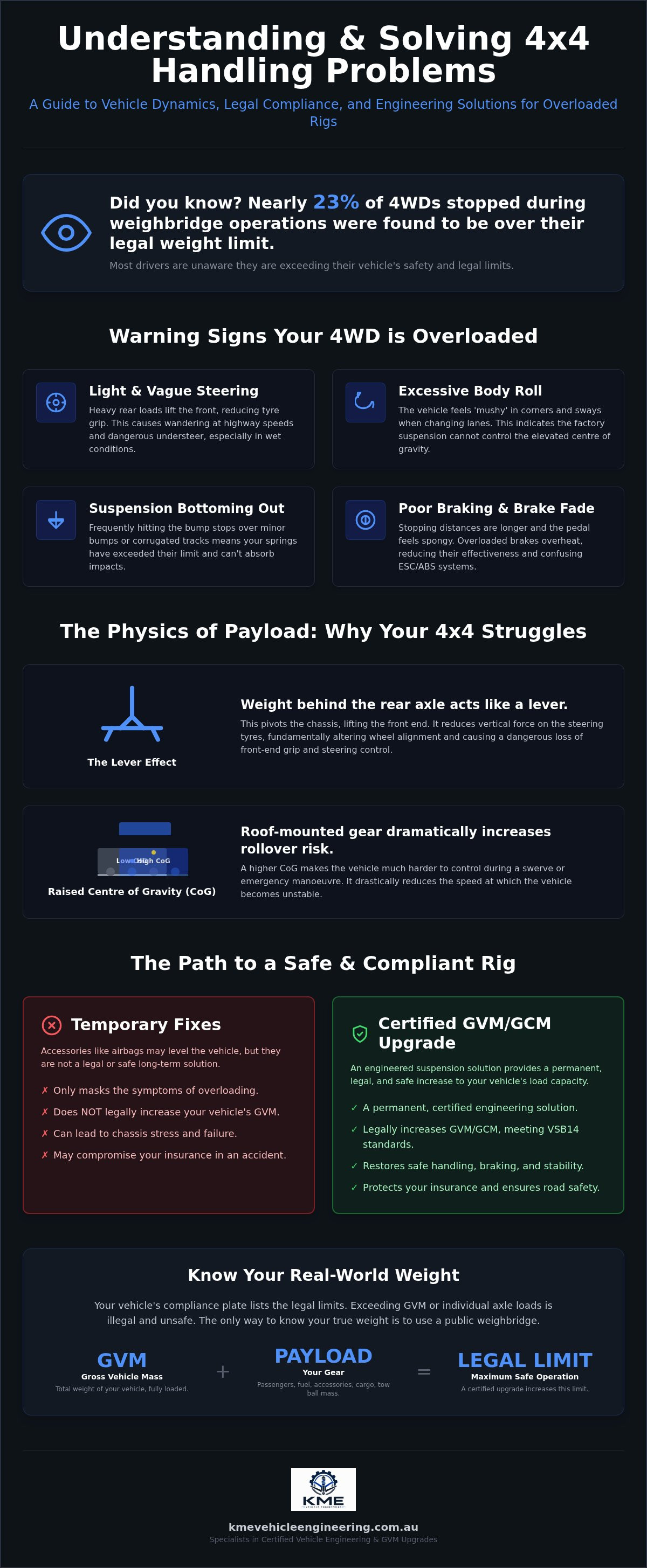
When you pack heavy gear behind the rear axle, the chassis acts like a lever. The rear load applies downward pressure that pivots the vehicle, effectively lifting the front end and reducing the vertical force on the steering tyres. This doesn't just make the steering feel disconnected or "vague"; it fundamentally alters your wheel alignment geometry. Toe and camber settings shift away from their optimal positions, causing the vehicle to wander across the road at highway speeds. On wet bitumen, this loss of front-end bite is particularly hazardous, as the tyres lack the grip required to track through a corner, leading to dangerous understeer.
Braking and Electronic Stability Control (ESC) Interference
Modern safety systems are finely tuned to the vehicle's original weight distribution and centre of gravity. When you're operating at high GCM, the braking system faces immense thermal stress. Factory rotors and pads often struggle to dissipate the heat generated by stopping a heavy rig, which leads to "brake fade." This is where the pedal feels spongy and stopping distances grow dangerously long. Additionally, excessive weight shifts can confuse Electronic Stability Control (ESC) and ABS sensors. If the vehicle "nose-dives" under heavy deceleration, the weight transfers forward too aggressively, which can trigger premature ABS intervention or incorrect brake force distribution.
This instability is also a primary driver of trailer sway. A poorly balanced tow vehicle fails to provide the necessary counter-force to keep a caravan or trailer tracked straight, especially when buffeted by crosswinds or passing trucks. Without a certified suspension solution, these electronic aids are forced to work outside their design parameters, reducing their effectiveness when you need them most. Ensuring your rig is balanced through proper engineering isn't just about comfort; it's about making sure your safety systems can actually do their job in an emergency.
The Physics of Payload: Why Your 4x4 Struggles When Packed
Every 4WD comes with a Gross Vehicle Mass (GVM) rating, which is the maximum legal weight of the vehicle including passengers, fuel, accessories, and the tow ball download. When you exceed this, or even approach the limit, you create 4x4 handling problems under load because the chassis and suspension components were never designed to manage that much energy. It's vital to distinguish between kerb weight, which is the vehicle empty, and payload, which is the gear you add. Your Gross Combination Mass (GCM) is the total weight of the vehicle and trailer together. On a rough Australian track, a "static" weight like a 60kg fridge doesn't stay static. When you hit a washout at 80km/h, that weight exerts a "dynamic" force several times its own mass. This kinetic energy must be absorbed by the suspension; if the springs and shocks aren't up to the task, the energy transfers directly into the chassis, leading to structural fatigue or failure.
Centre of Gravity and Rollover Risk
Mounting heavy gear like spare tyres or fuel cans on a roof rack significantly raises the vehicle's centre of gravity (CoG). This heightens the "polar moment of inertia," making the vehicle more resistant to starting a turn but much harder to stop once it begins to lean. A loaded ute often carries its weight further back than a wagon, which changes how the vehicle reacts during an emergency swerve. Maintaining strict safety and compliance standards is essential for preventing rollovers, as a high CoG drastically reduces the speed at which a vehicle becomes unstable and safe to operate.
Axle Load Limits vs. Total GVM
Many owners assume they're safe if they stay under their total GVM. This is a dangerous misconception. You can be legally under your total weight limit while significantly exceeding the individual rear axle rating. Accessories like dual spare wheel carriers create a "fulcrum effect," where weight hanging behind the rear axle acts as a lever, multiplying the load on the rear suspension while simultaneously lifting the front. This specific weight distribution issue is a major contributor to 4x4 handling problems under load. You can find these specific axle limits on the compliance plate located on your door pillar or under the bonnet. If you're struggling to balance your load, a professional GVM assessment can identify whether your rig's weight distribution is within safe engineering tolerances.
Many owners try to mask 4x4 handling problems under load with bolt-on accessories that provide a visual fix but ignore the underlying mechanical strain. While a set of helper springs might stop the rear from sagging, they don't increase the vehicle's legal capacity or improve the braking performance required for a heavier mass. An engineering-based approach looks at the vehicle as a holistic system rather than a collection of parts. This is supported by the FHWA study on vehicle weight and handling, which highlights how increased weight fundamentally alters roll stability and braking efficiency. Ignoring these factors creates a rig that might look correct on the driveway but fails when subjected to emergency manoeuvres.
The Airbag Myth: Level Does Not Mean Legal
Airbags are a common band-aid. They level the ride, which fixes the "look" of a sagging rear. However, they don't fix the steering geometry issues discussed earlier. More importantly, they concentrate load onto a small section of the chassis rail that wasn't designed to carry the entire weight of the payload. This often leads to chassis cracking, especially on corrugated outback roads. A level rig isn't necessarily a safe or legal one if the underlying components are over-stressed. Airbags can actually worsen handling by creating a pivot point that reduces the effectiveness of the vehicle's primary suspension.
Why Springs Alone Are Not a GVM Upgrade
Simply fitting "heavy-duty" springs is another frequent mistake that fails to address 4x4 handling problems under load. Without matched shock absorbers, these stiffer springs can't control the rebound of a heavy load, leading to a bouncy, unpredictable ride on uneven surfaces. For vehicles like the Toyota flagship, 300 Series Landcruiser suspension kits must be engineered as a complete system to ensure ADR compliance. A true GVM upgrade involves rigorous testing of the brakes, axles, and chassis strength to verify the vehicle can safely stop and turn at its new weight rating. Without an engineering signatory and a revised compliance plate, your insurance provider may view your modifications as unauthorised, potentially voiding your cover in the event of an accident.
The legal distinction is critical. A standard aftermarket suspension lift is not a GVM upgrade. If your vehicle is weighed at the roadside or after a collision and found to be over its original factory GVM, the presence of heavy-duty springs won't protect you from liability. Only a certified GVM upgrade provides the legal framework to operate a heavy vehicle safely on Australian roads. This process ensures that every component, from the brake rotors to the axle housings, is capable of managing the increased dynamic forces of a fully loaded tourer.
Assessing Your Rig: How to Calculate Real-World Weight
Determining your vehicle's actual mass is the only way to accurately diagnose 4x4 handling problems under load. Most owners rely on guesswork, but a visual check of your suspension sag is a poor substitute for hard data. To get a clear picture of your rig's health, you must account for every accessory, fluid, and passenger. It's common for a modern 4WD to lose up to 300kg of its rated payload before a single person climbs inside, simply due to the weight of essential touring modifications. If you're unsure where your vehicle stands, comparing your actual weight against the legal GVM upgrade requirements is the first step toward a safer setup.
The Weighbridge Process
Achieving an accurate assessment requires a visit to a public weighbridge while your vehicle is in "trip-ready" condition. This means having full fuel tanks, water tanks topped up, and all recovery gear on board. For the most useful data, you should weigh your front and rear axles separately. Drive your front wheels onto the scale first to record the steer axle weight, then pull the entire vehicle onto the plate for the total Gross Vehicle Mass. Finally, drive forward so only the rear wheels remain on the scale. This split-axle data reveals whether your weight distribution is centrally balanced or if you're putting undue stress on a single end of the chassis, which is a primary cause of unpredictable steering response.
Accounting for Accessories and Passengers
Hidden weight is often the culprit behind front-end sag and poor braking. A steel bull bar and winch combo can easily add 100kg to the very front of your chassis, while a long-range fuel tank adds significant mass right in the middle of the frame. Diesel weighs roughly 0.8kg per litre, meaning a 180-litre tank adds 144kg in fuel alone, plus the weight of the steel or polymer tank itself. On dual-cab utes, a fully loaded canopy creates a massive load behind the rear axle, often exceeding the factory limits before you've even hitched a trailer.
Don't forget that Tow Ball Mass (TBM) counts as part of your vehicle's payload. If your caravan has a 250kg TBM, that weight is applied directly to your rear axle, often acting as a lever that lifts the front wheels. This specific imbalance is a major contributor to 4x4 handling problems under load and can't be fixed by simply moving gear around in the tub. If your weighbridge results indicate you're operating near your limits, a professional GVM consultation can help you determine the best path toward a certified engineering solution.
Solving Handling Issues with a Certified GVM or GCM Upgrade
A certified Gross Vehicle Mass (GVM) upgrade is the only legally recognised method to permanently resolve 4x4 handling problems under load. Unlike basic suspension swaps, a certified upgrade involves a comprehensive engineering assessment that verifies the vehicle's ability to safely manage increased mass without compromising structural integrity. This process ensures that your rig remains compliant with the Road Vehicle Standards (RVS) laws that came into effect on July 1, 2021. By obtaining a modification plate, you provide proof to authorities and insurers that your vehicle meets the stringent safety requirements detailed in Vehicle Standards Bulletin 14 (VSB14). This isn't just about a smoother ride; it's about ensuring your vehicle's mechanical design matches its real-world application.
The Engineering Certification Process
The path to compliance requires vehicle engineering certification in Australia to validate that every component can handle the extra stress. An engineer doesn't just look at the springs; they assess the entire chassis, the braking efficiency, and the axle load ratings. There's a distinct difference between pre-registration (Second Stage Manufacture) and post-registration upgrades. Pre-registration is often more streamlined, while post-registration requires a state-based signatory engineer to inspect the vehicle and issue a certificate. This verification is an investment in your vehicle's resale value, as a certified GVM increase is a highly desirable feature for future buyers who want a rig that is legally fit for purpose.
Tailored Solutions for the 300 Series Landcruiser
Modern vehicles like the 300 Series Landcruiser present unique engineering challenges due to their sophisticated electronic safety suites. A bespoke suspension kit must do more than just carry weight; it must integrate seamlessly with factory Electronic Stability Control (ESC) and Autonomous Emergency Braking (AEB) systems. When we design a solution for the 300 Series, we ensure the new spring rates and dampening characteristics don't interfere with these sensors, maintaining the vehicle's protective features even when fully loaded. This high-level integration is what separates a professional engineering solution from a generic aftermarket kit. If you're tired of a rig that feels unsettled on the highway, you should consult with KME Vehicle Engineering for a certified solution to your handling problems.
Secure Your Rig’s Performance and Compliance
Resolving 4x4 handling problems under load requires moving beyond visual fixes like airbags or helper springs. True safety and stability are found in a holistic engineering approach that accounts for braking efficiency, chassis integrity, and precise axle load distribution. By accurately weighing your vehicle in a trip-ready state and seeking professional certification, you protect both your passengers and your legal standing. A compliant vehicle isn't just about avoiding fines; it's about ensuring your rig behaves predictably when you need it most, whether you're navigating a steep mountain pass or executing an emergency swerve on the highway.
At KME Vehicle Engineering, we specialise in 300 Series Landcruiser solutions and provide nationally recognised engineering certification to ensure your modifications align with VSB14 and VSB6 standards. Our technical mastery allows us to solve complex weight distribution puzzles, giving you the confidence to explore remote tracks without compromising on safety or insurance cover. Don't leave your vehicle's dynamics to chance. Get an Engineering Assessment for Your Rig today and experience the difference of a professionally engineered setup. Travel with the peace of mind that comes from a rig that is both technically capable and fully compliant.
Frequently Asked Questions
Is it illegal to drive my 4x4 if it is over the GVM limit?
Yes, operating a vehicle above its Gross Vehicle Mass is illegal and renders the vehicle unroadworthy. Roadside compliance checks are increasing across Australia, with authorities like Victoria Police conducting over 1,200 weighbridge operations annually. If you're found to be overloaded, you face significant fines and the potential for your vehicle to be grounded. More importantly, you're operating outside the safety parameters for which the chassis and brakes were designed.
Can a GVM upgrade actually improve my vehicle's handling or just carry more weight?
A certified upgrade does both by matching spring rates and dampening characteristics to your vehicle's actual working weight. It directly resolves 4x4 handling problems under load by restoring correct steering geometry and reducing excessive body roll. While the primary goal is a higher legal limit, the engineering process ensures the vehicle remains stable and predictable during emergency manoeuvres, providing a far more planted feel than a factory setup pushed to its limits.
Do I need an engineering certificate for a 2-inch lift kit?
Generally, a 50mm lift does not require certification if it complies with VSB14 guidelines and doesn't exceed the maximum combined lift limit, which is usually 75mm including tyres. However, if the lift is part of a GVM upgrade, it must be certified as a complete system. Because administrative requirements are managed by each state and territory, you should always verify local regulations to ensure your specific modification remains compliant and legal.
How much does a GVM upgrade typically increase my payload by?
The increase depends on the vehicle's chassis strength and the specific engineering kit used. For a 79 Series LandCruiser, a typical upgrade can increase the GVM from 3,510kg to 3,950kg or 4,200kg, providing up to 690kg of additional payload. Recent factory options for the Toyota Hilux now offer increases to 3,500kg. These upgrades are designed to provide a safe, legal margin for permanent accessories like canopies, bull bars, and long-range fuel tanks.
Will a GVM upgrade void my new car warranty?
A GVM upgrade won't void your entire new car warranty, though the manufacturer is not responsible for failures caused directly by the modification. Your engine and electronics warranties typically remain intact, while the upgrade provider covers the new suspension components. Some manufacturers now offer factory-approved options to maintain full warranty coverage. It's essential to use an ADR-compliant kit fitted by a qualified specialist to ensure your consumer rights and vehicle integrity are protected.
What happens if I have an accident while my vehicle is overloaded?
Insurance companies are increasingly scrutinising vehicle weight during accident investigations. If your 4WD is found to be over its legal limit, the insurer may deny your claim entirely, leaving you personally liable for damages. Furthermore, you could face criminal charges if the overload contributed to the incident. A certified GVM upgrade provides the necessary legal protection to ensure your insurance remains valid when you are travelling with a fully loaded rig.
Can I upgrade my GCM to tow a heavier caravan legally?
Gross Combination Mass (GCM) upgrades are separate from GVM upgrades and are subject to stricter regulations. For already registered vehicles, these upgrades require a detailed inspection and certification by a registered signatory engineer. While some Second Stage Manufacturers can nominate an increased GCM for pre-registered vehicles, the rules for used vehicles vary by state. You must verify current state-based regulations to see if a GCM revision is possible for your specific vehicle.
Do I need to visit an engineer if I only fit heavy-duty springs?
If you only fit stiffer springs without a certified GVM upgrade, you don't need an engineering certificate, but your legal payload remains unchanged. Stiffer springs might disguise 4x4 handling problems under load by levelling the ride, but they don't provide the legal verification required for insurance compliance. To legally carry more weight than the factory compliance plate allows, you must complete a full certified engineering process and have a new modification plate fitted.


Comments